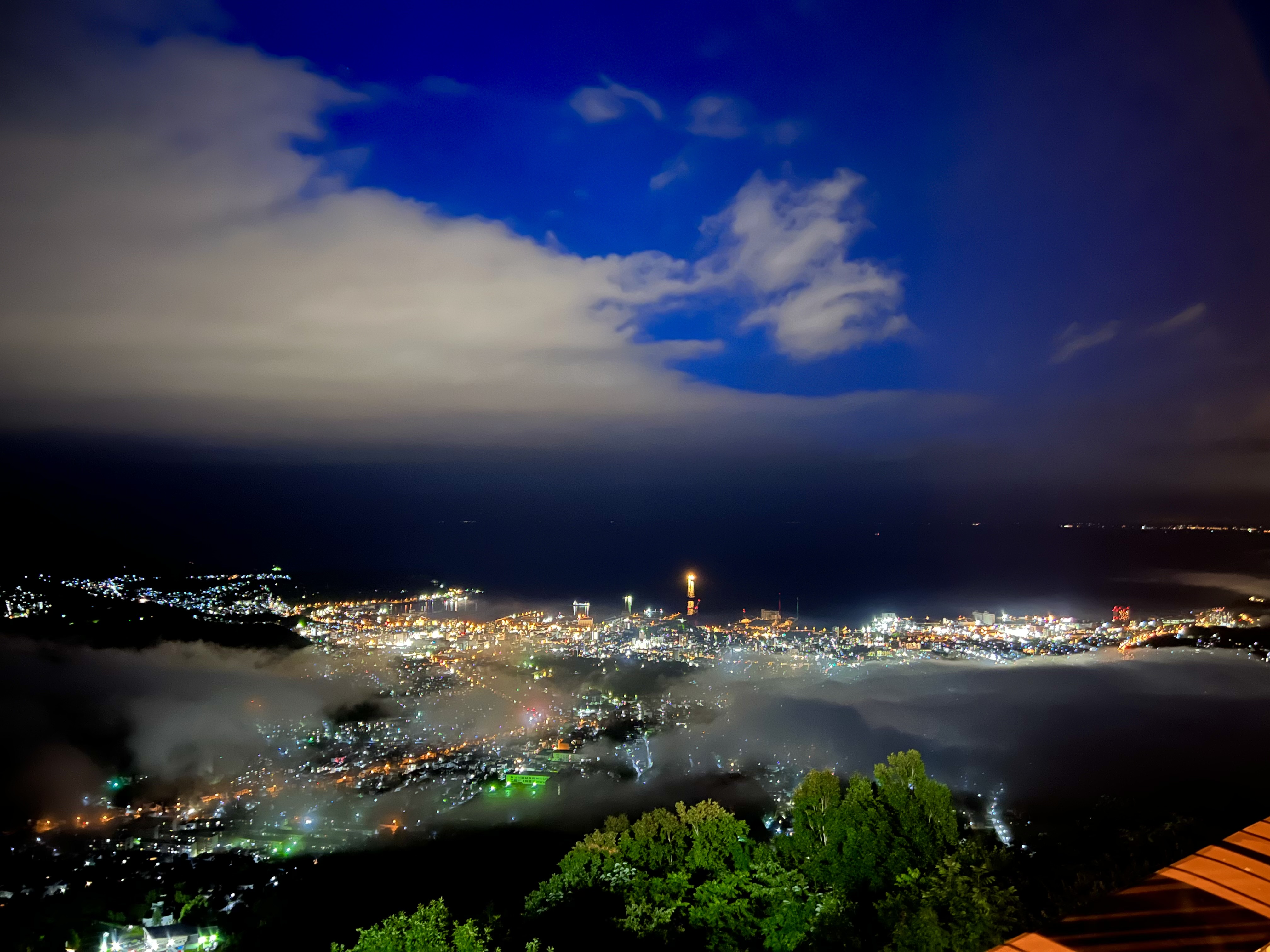
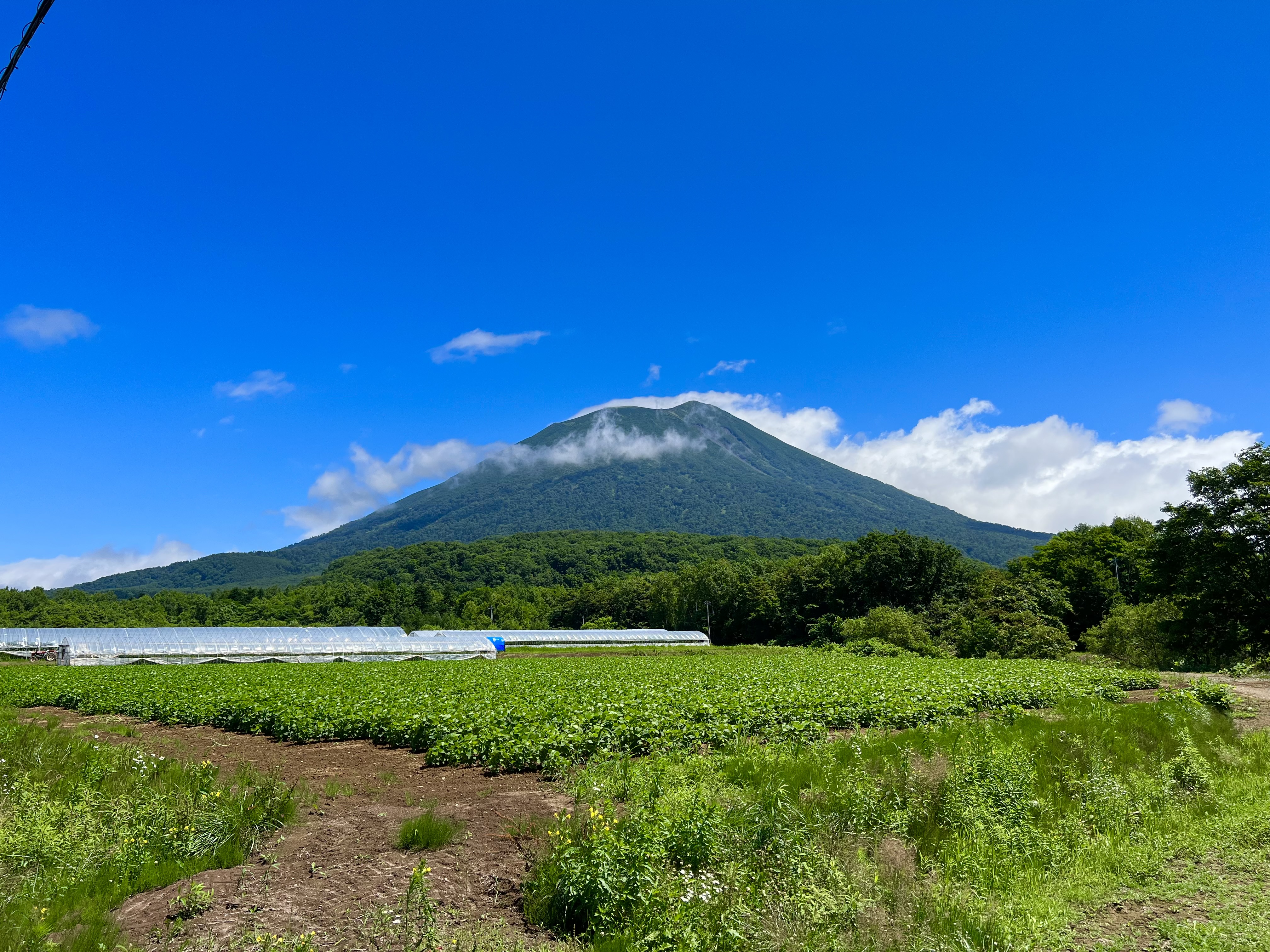
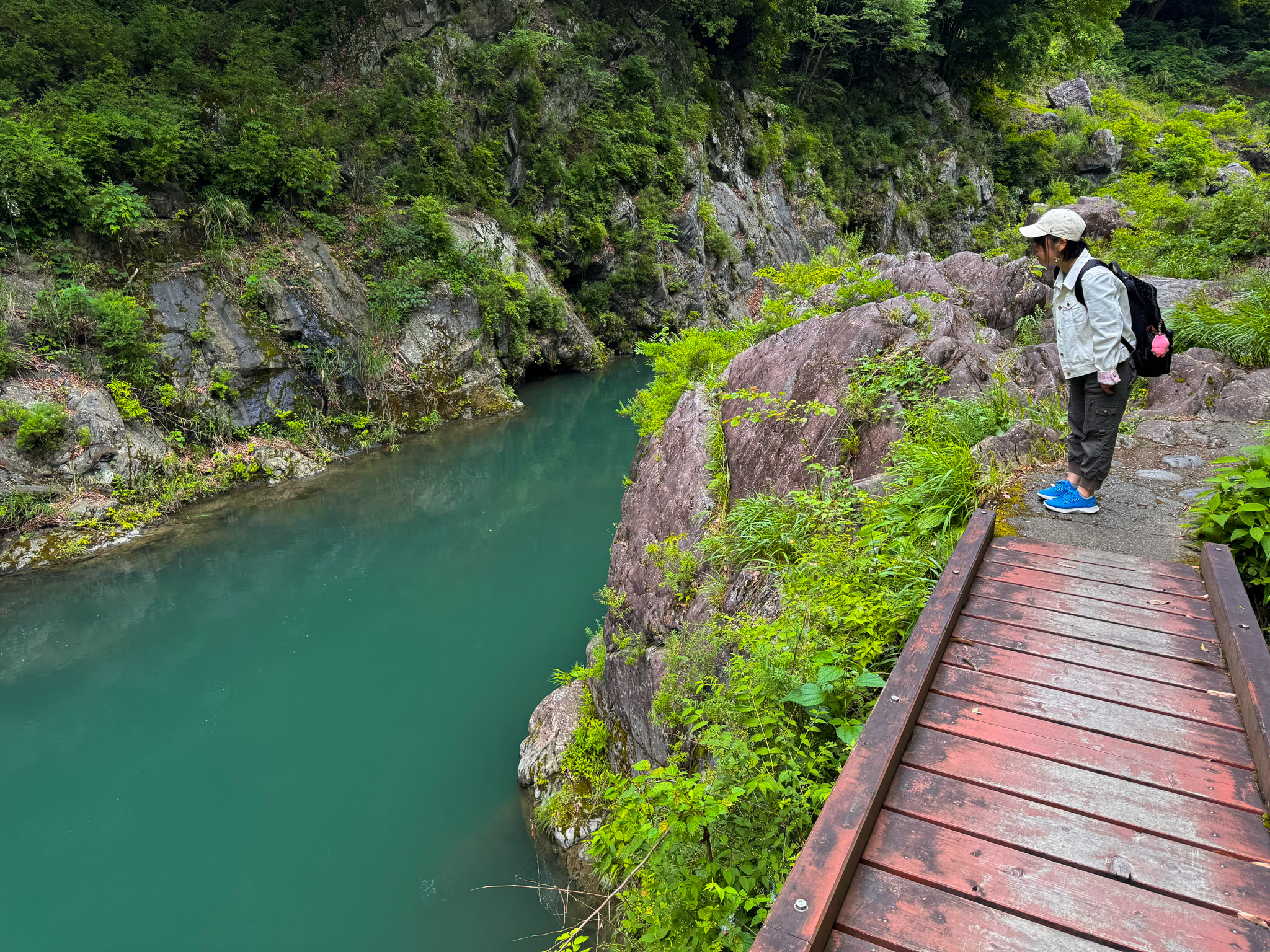
December 2020. Japan was technically open and we were going to Kyushu. An early flight out of Haneda, a rental car in Kumamoto, a shrine in the mountains that stopped us cold, a drive over the Aso caldera above a sea of clouds, and a night at a ryokan in Kurokawa where a cat met us at the door and the onsen smelled of sulfur and was exactly what December required.
The 8:20AM JAL flight out of Haneda put us on the ground in Kumamoto just past 9:30. Masks on, as required — Japan had its own relationship with the pandemic throughout 2020, and by December the rules were settled and consistent. Nobody argued about it. You just wore the mask.
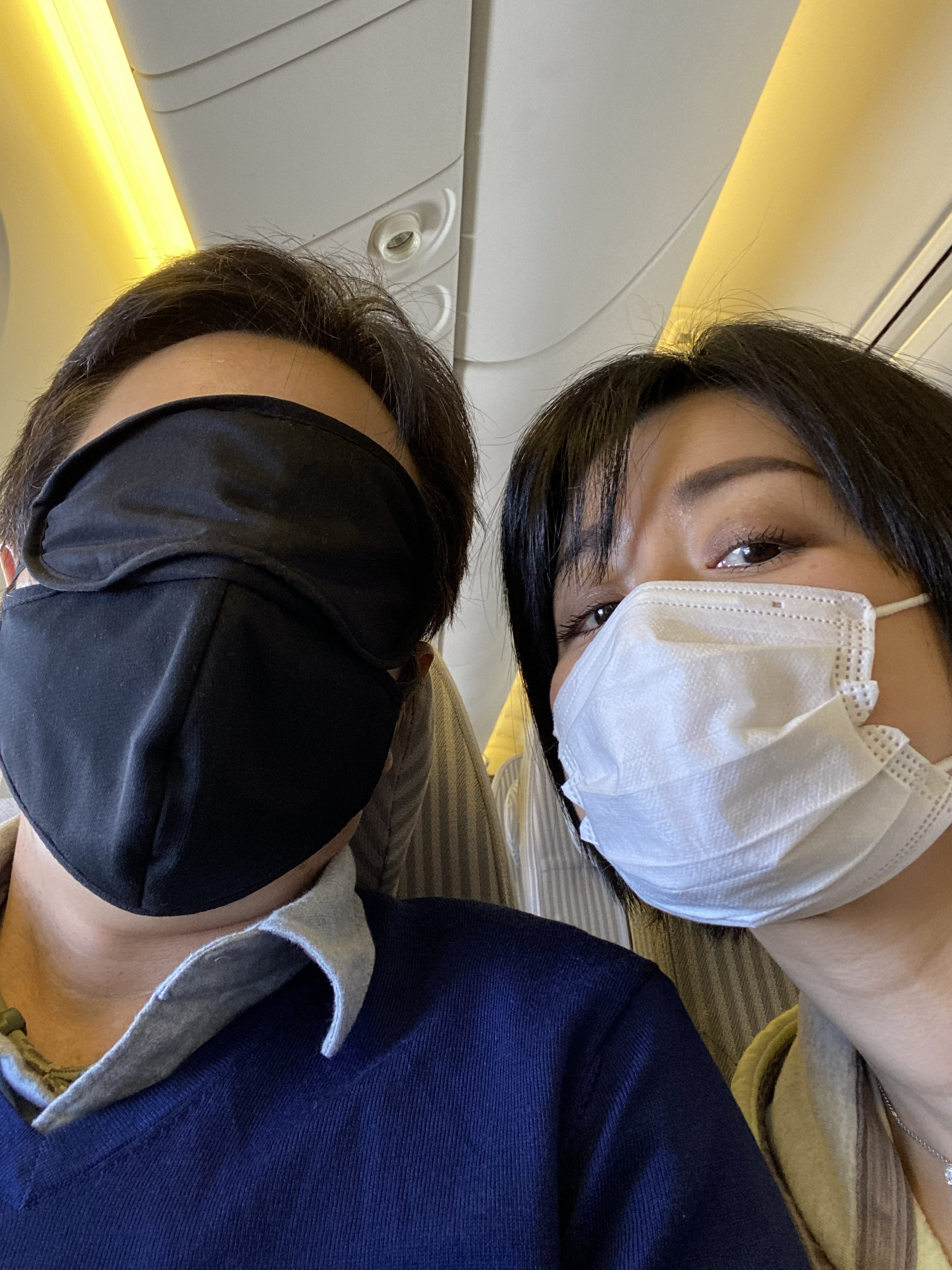
John and Ayumi, masked up for the hop from Haneda. Covid travel, Japanese-style.
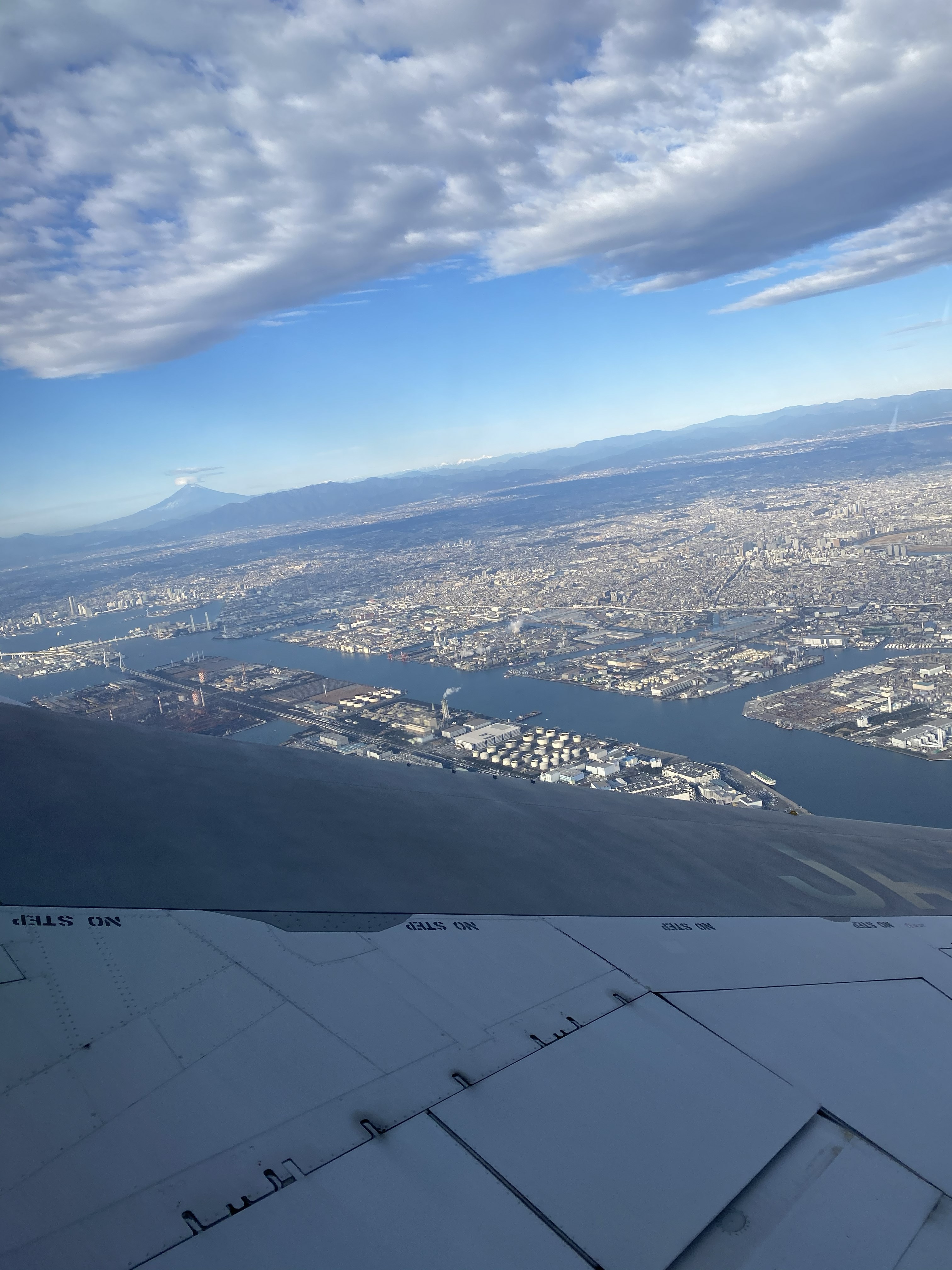
Leaving Haneda. Tokyo Bay below, Fuji just barely on the horizon.
We picked up a rental car at the airport — a blue Nissan Note — and drove toward Takamori, a small town in the Aso region southeast of Kumamoto city. The destination was Kamishikimi Kumanoimasu Shrine, 上色見熊野座神社, which I had been wanting to see for a while. From the road it looks almost modest. Then you see the staircase.
Kamishikimi Kumanoimasu Shrine
The grounds open with a stone torii gate draped in a thick shimenawa rope, and wide stone steps flanked by komainu — the moss-covered lion-dog guardians that look like they are slowly returning to the earth they were carved from. Stone lanterns run in rows up the hill. Tall sugi trees close in on both sides. Everything is layered in moss — the stone, the statues, the lanterns, the walls. A quiet green that takes over anything that sits still long enough. Within the grounds, nagi trees — 梛 — are planted as the shrine's goshimboku, the sacred tree. Nagi is the tree of Kumano shrines throughout Japan.
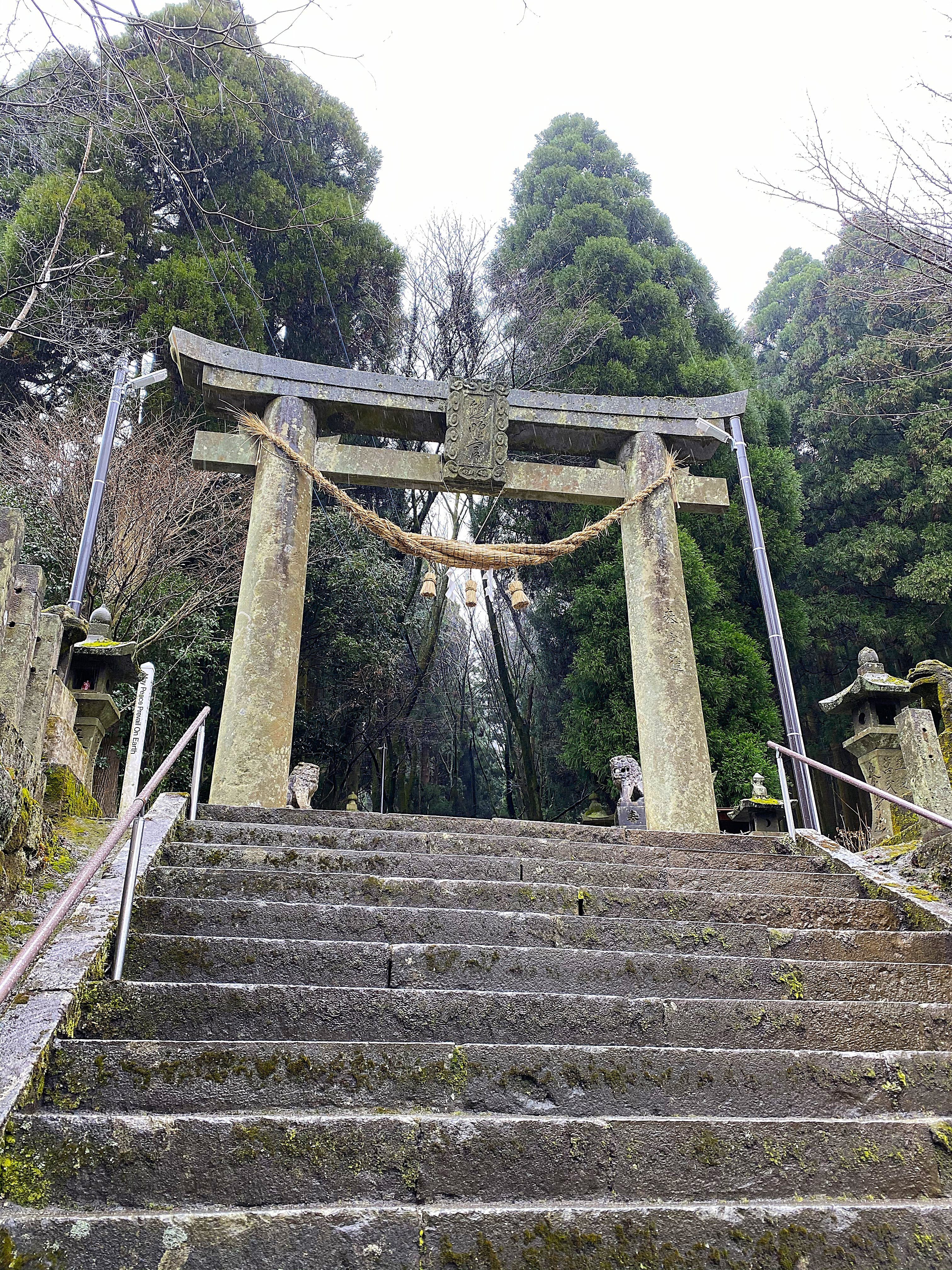
The first torii. Shimenawa rope between the pillars, sugi disappearing into the overcast above.
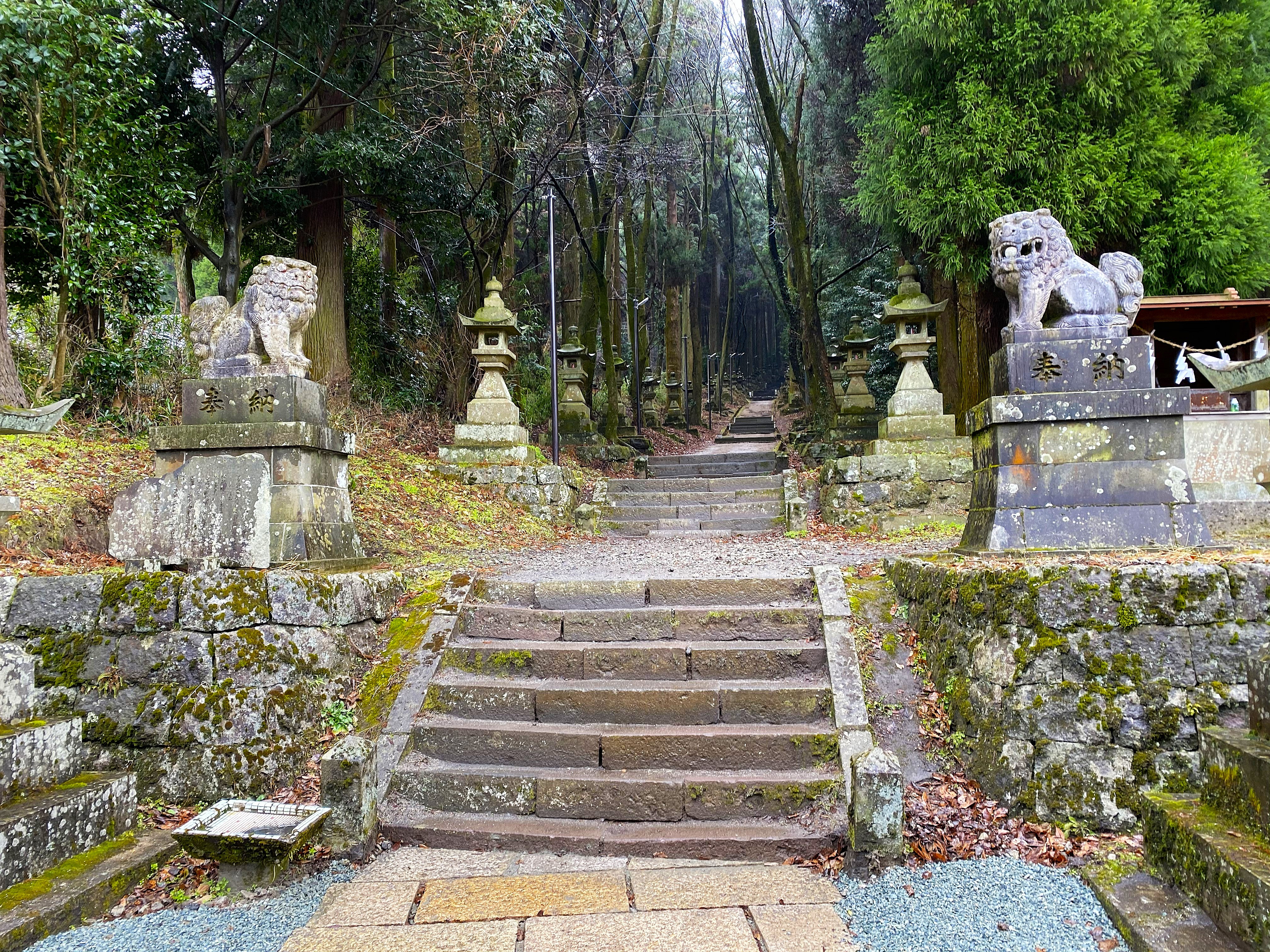
Komainu on both sides, lanterns running all the way up. The bases read 奉納 — offered in dedication.
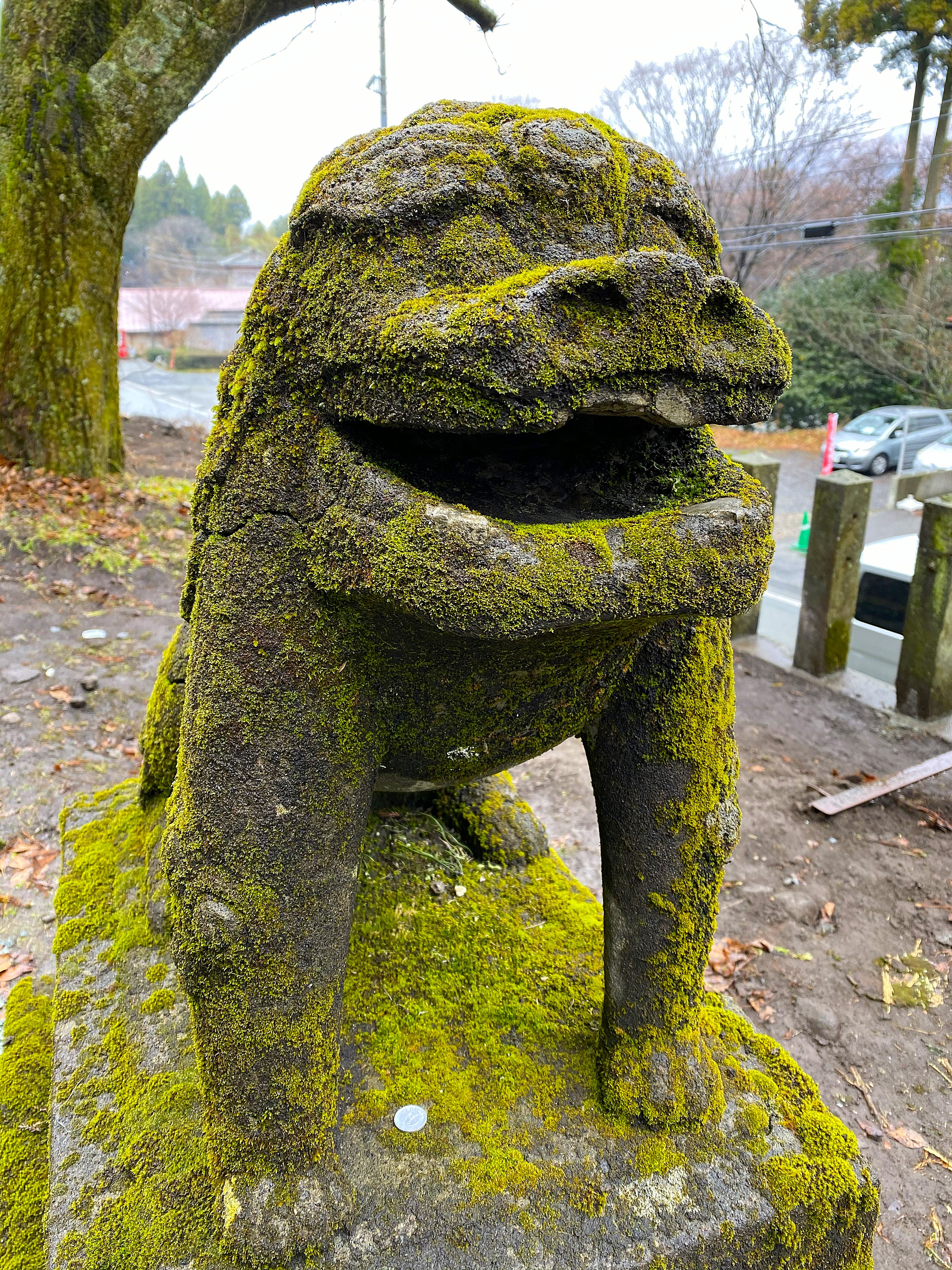
One of the komainu at the entrance. Almost entirely reclaimed by moss.
Past that first gate is a flat stone walkway — a pause between climbs. The path is wide and lined with sugi trunks and lanterns as far as you can see. You hear your own footsteps. A second torii marks the far end where the next staircase begins.
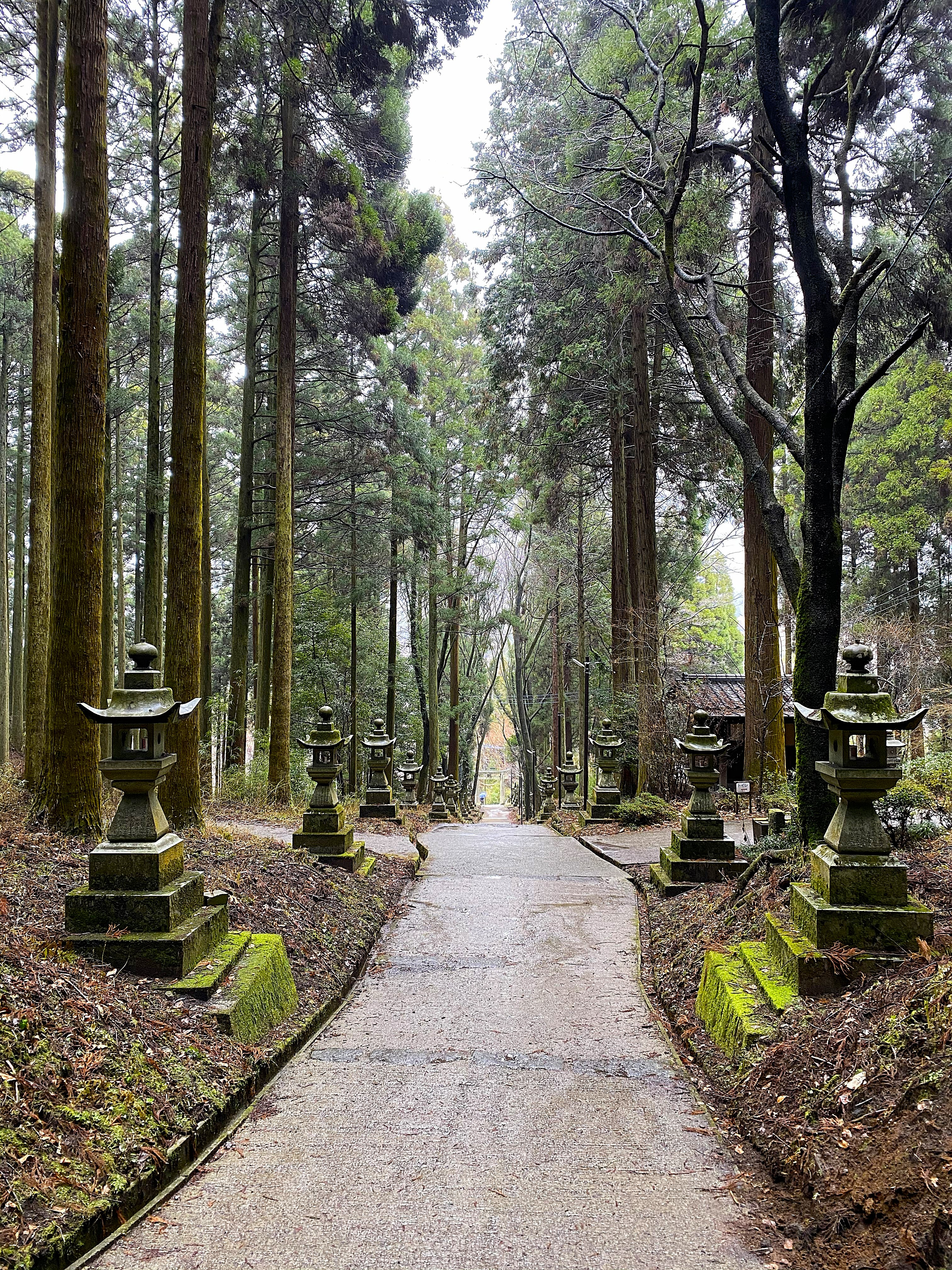
The flat section between the staircases. A long, quiet corridor of lanterns and sugi.
Then the main staircase opens up. This one is a straight run of dark, wet stone steps rising through a corridor of ancient sugi — mossy lanterns standing sentinel on each side, the trees getting bigger as you climb, a distant torii barely visible at the top. It is the kind of thing that makes you stop and take a breath before you start.
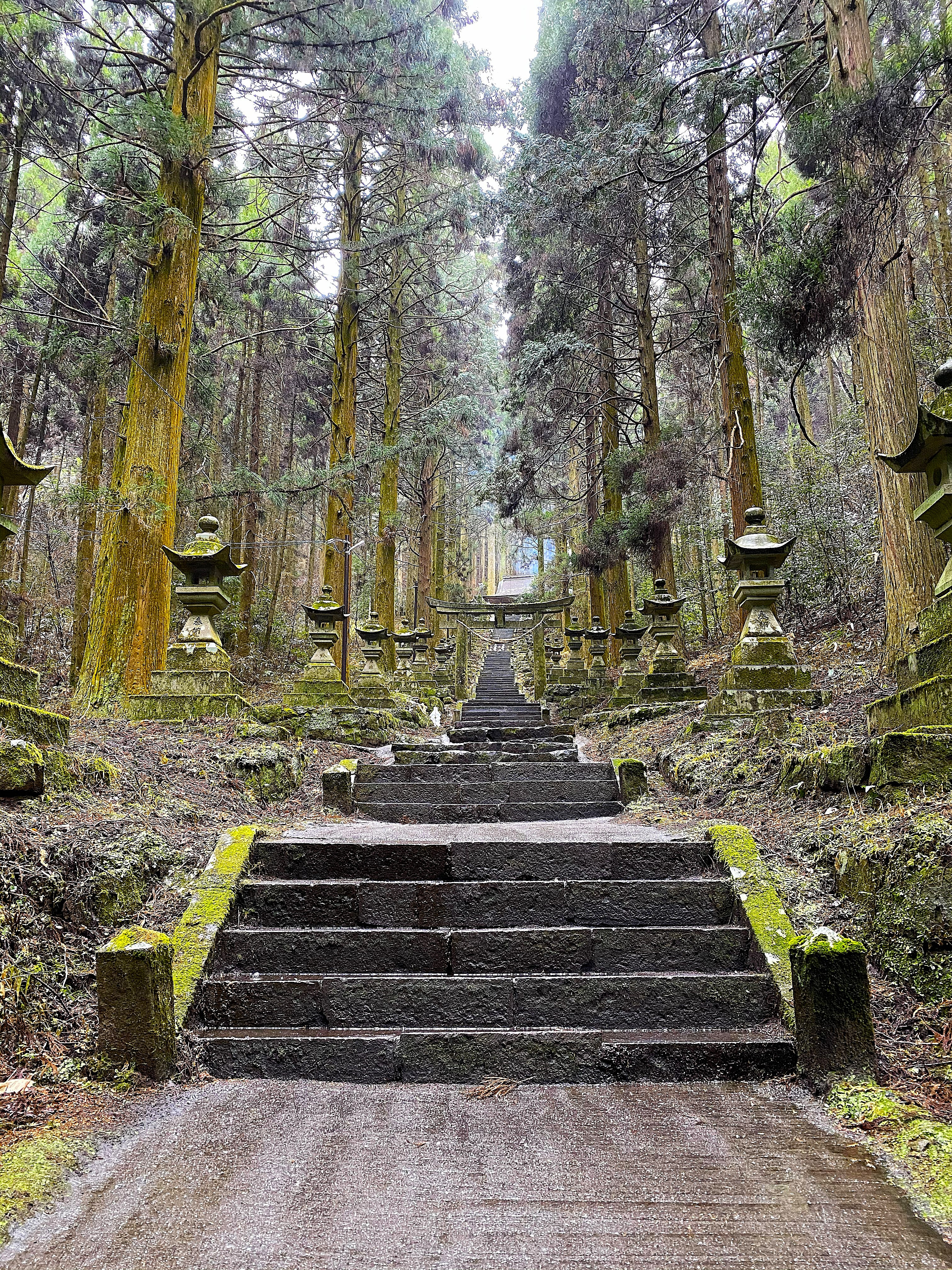
The main staircase. The sugi are enormous — the photos don't fully capture it.
The climb takes about ten minutes at a slow pace. By the top the trees are massive, the air noticeably colder, and on a December weekday there were almost no other visitors. Just the wind and the occasional crow.
The Cave Shrine
Past the main sanctuary, a narrow path drops into the hillside. The terrain changes — manicured stone steps give way to rough-cut granite set into a dirt slope, the vegetation thicker, a shimenawa rope marking something sacred ahead. Then the hill opens into a massive volcanic rock face: a natural arch formed by a huge basalt overhang. Tucked into a recess in the cliff is a small cave shrine — a few steps, an offering box, a wooden placard. The scale of the rock above makes the whole thing feel ancient in a way that the staircase, for all its drama, does not.
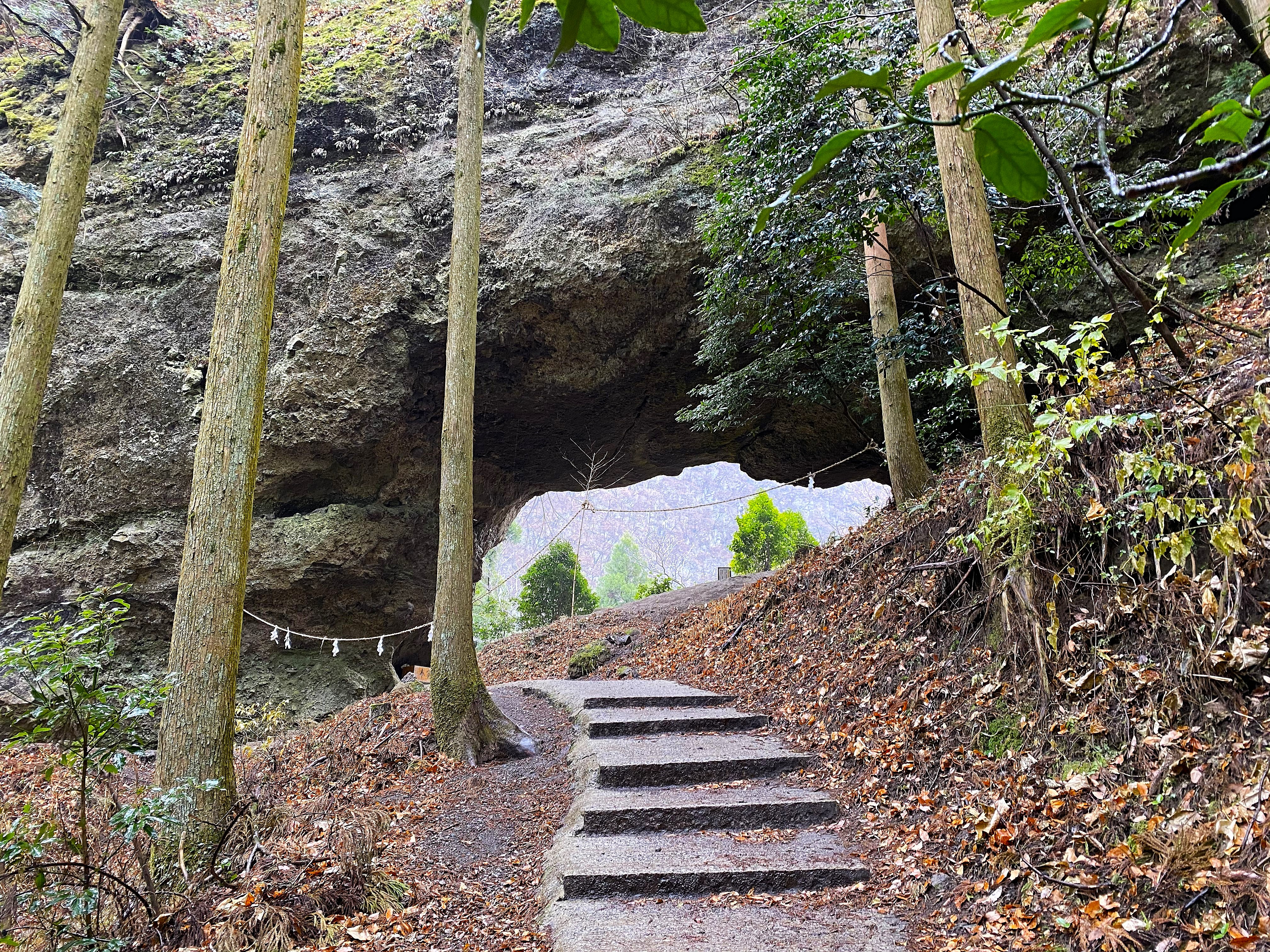
The approach. The overhang becomes visible through the trees as you climb.
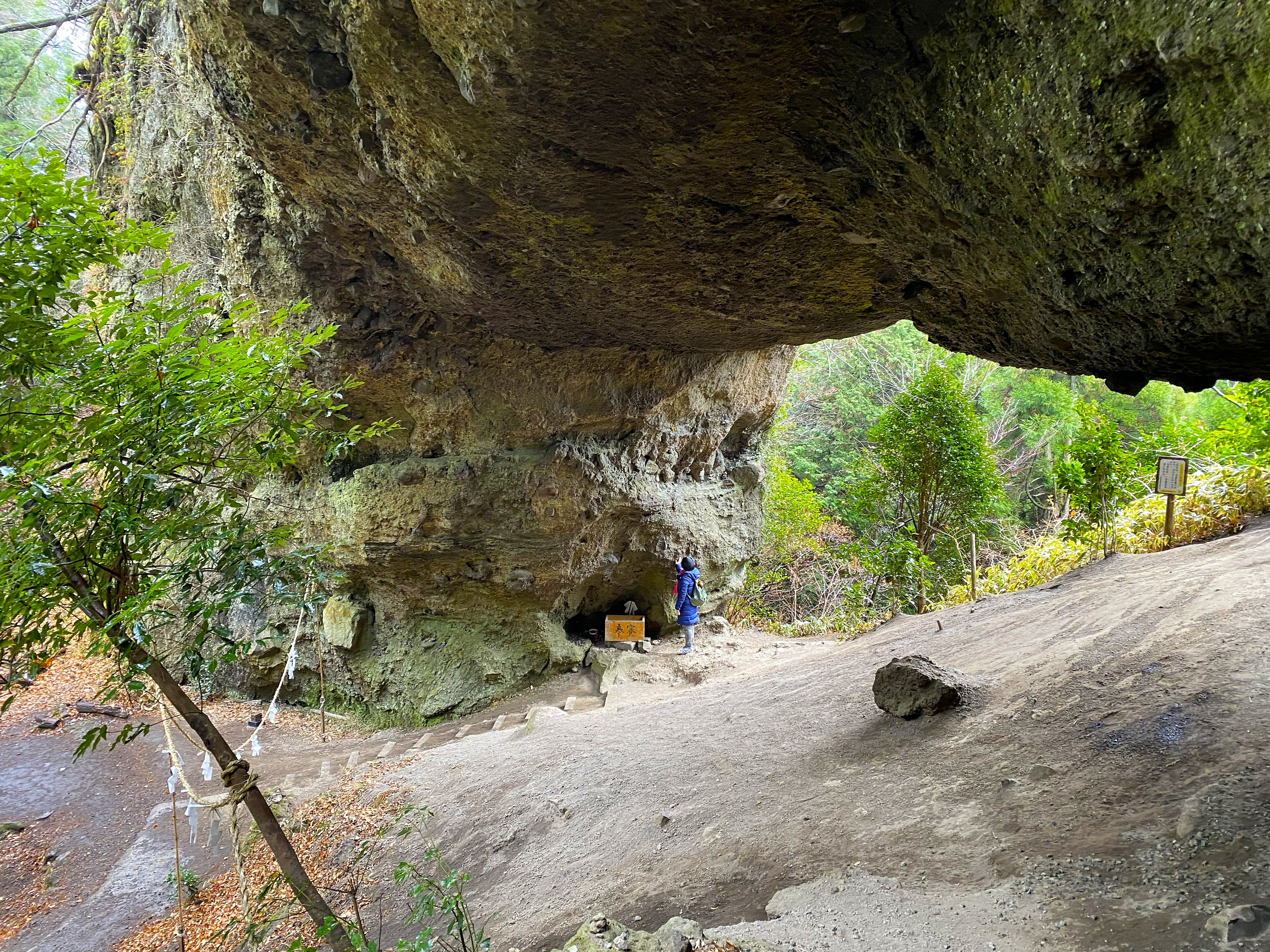
Ayumi photographing the cave shrine. The overhang is larger than it looks — the figure gives it scale.
The sugi lining the staircase are old enough that you start looking at them differently. Not as trees you walk past, but as things that were here long before the shrine was built around them.
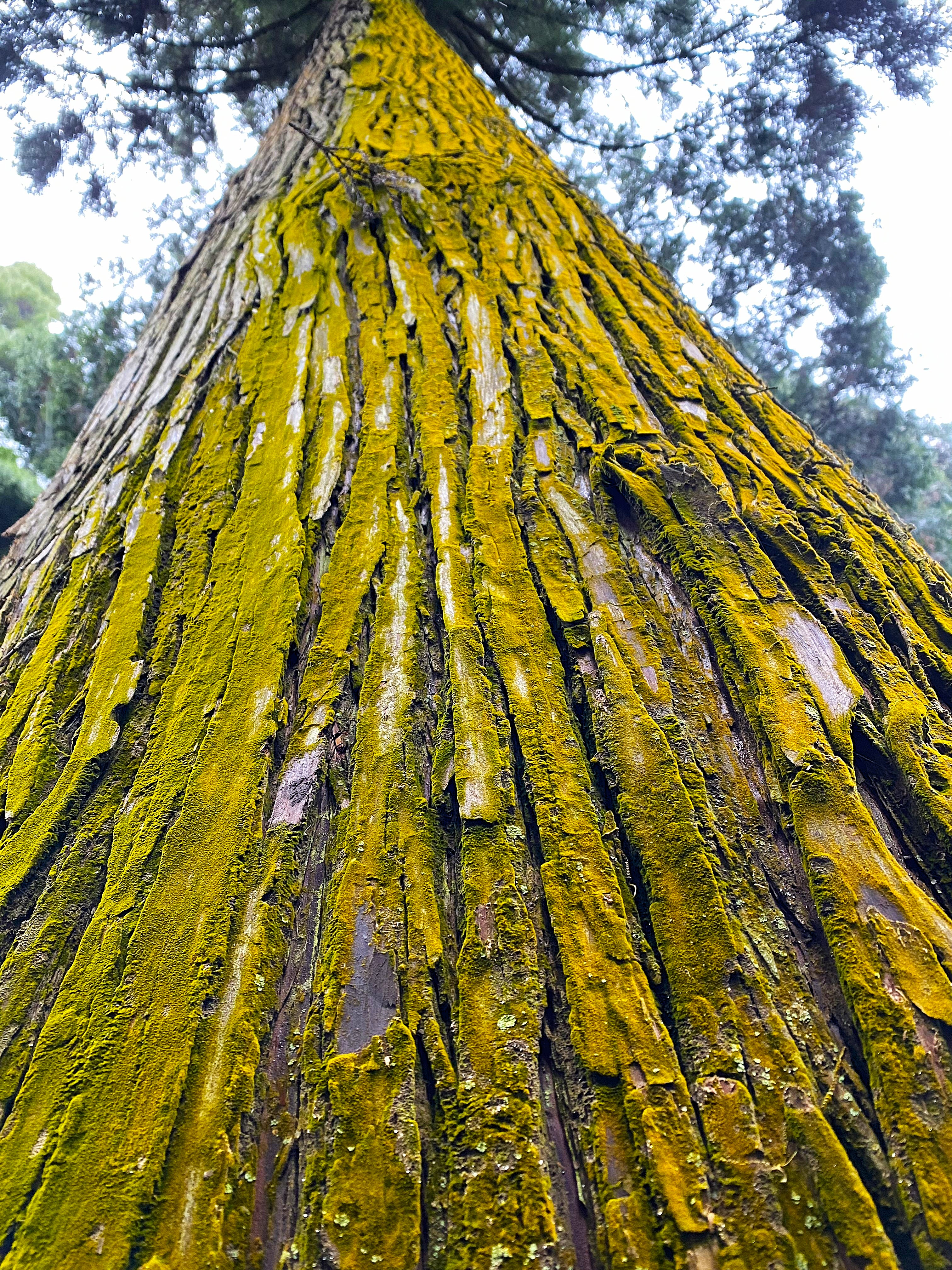
Looking straight up at one of the sugi on the main staircase. The moss grows in vertical stripes along the bark.
Over the Caldera
We got back to the car and drove north toward Kurokawa Onsen. The route crosses the Aso caldera — one of the largest volcanic calderas in the world — and the landscape transforms completely. Forest gives way to open volcanic grassland, golden in December, and then the road curves up around Mt. Aso itself.
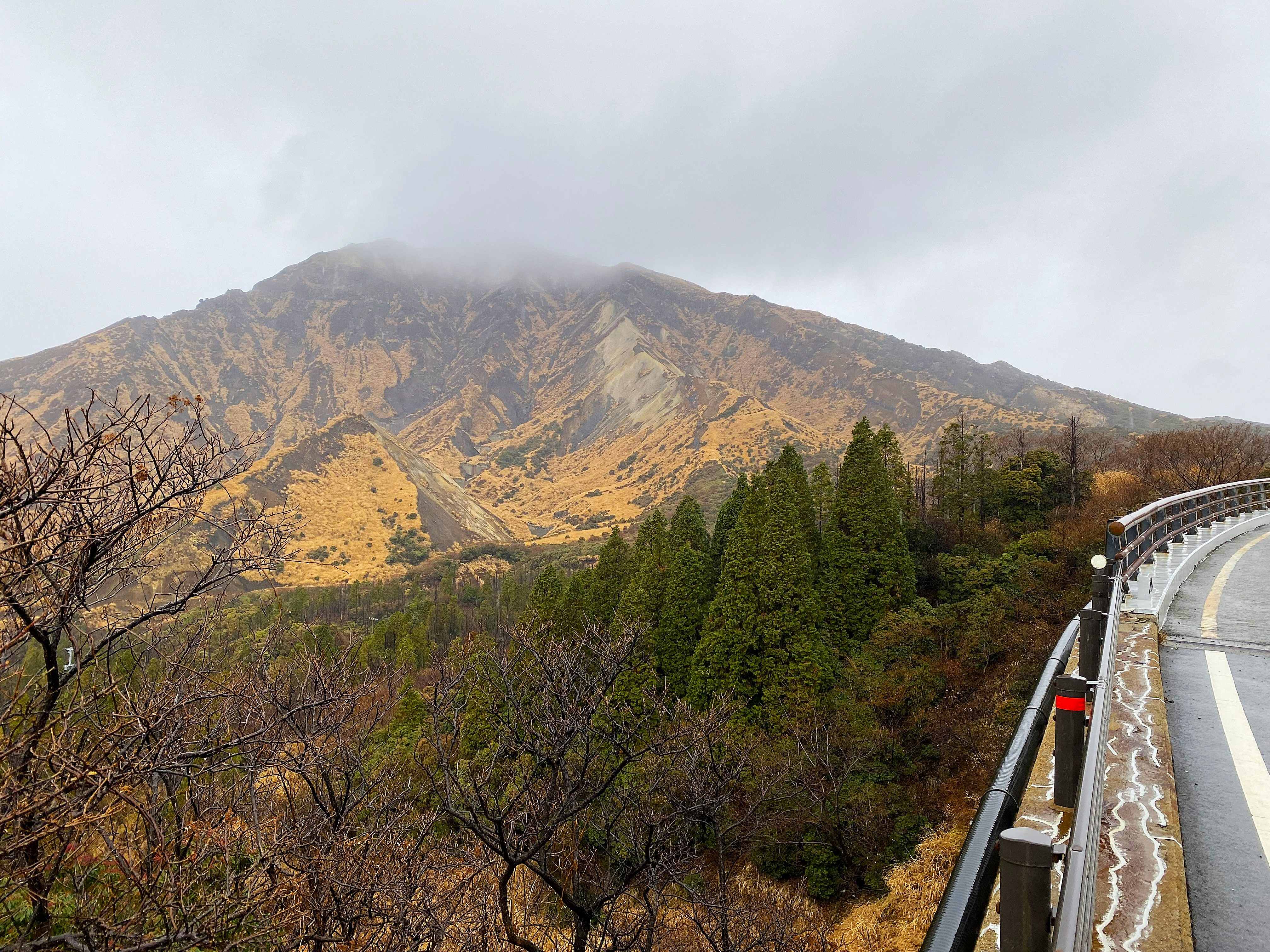
Mt. Aso from the road. Low cloud on the summit, the upper slopes bare in December.
We stopped at a viewpoint near the crater area. The parking lot was empty and we had the place to ourselves. From the rim, Aso City below had completely disappeared under cloud — a solid white sea stretching to the far wall, golden grass on the slopes above it, sky breaking through overhead. One of those moments that holds.
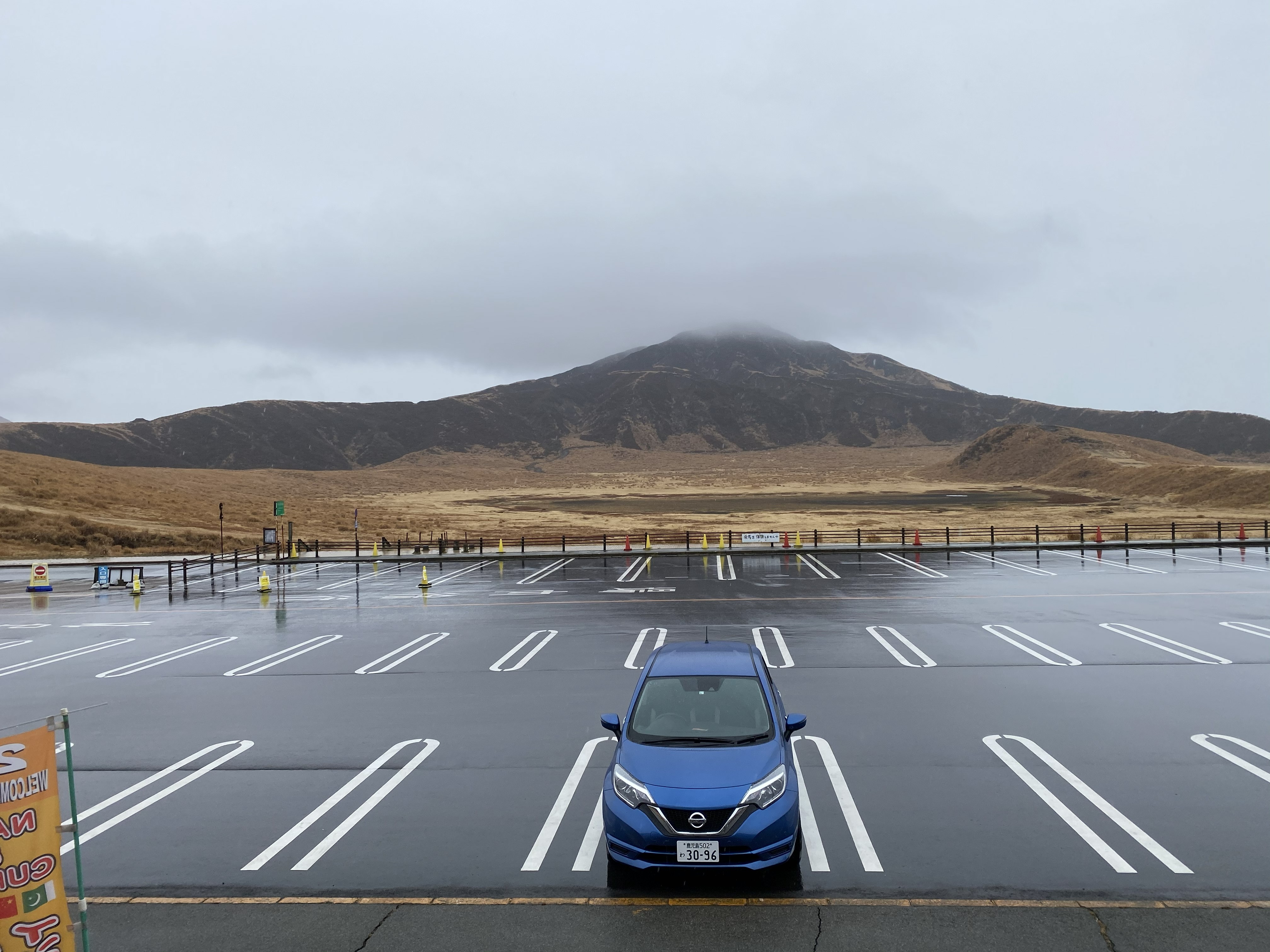
The rental, alone in the lot. Mt. Eboshi directly behind.
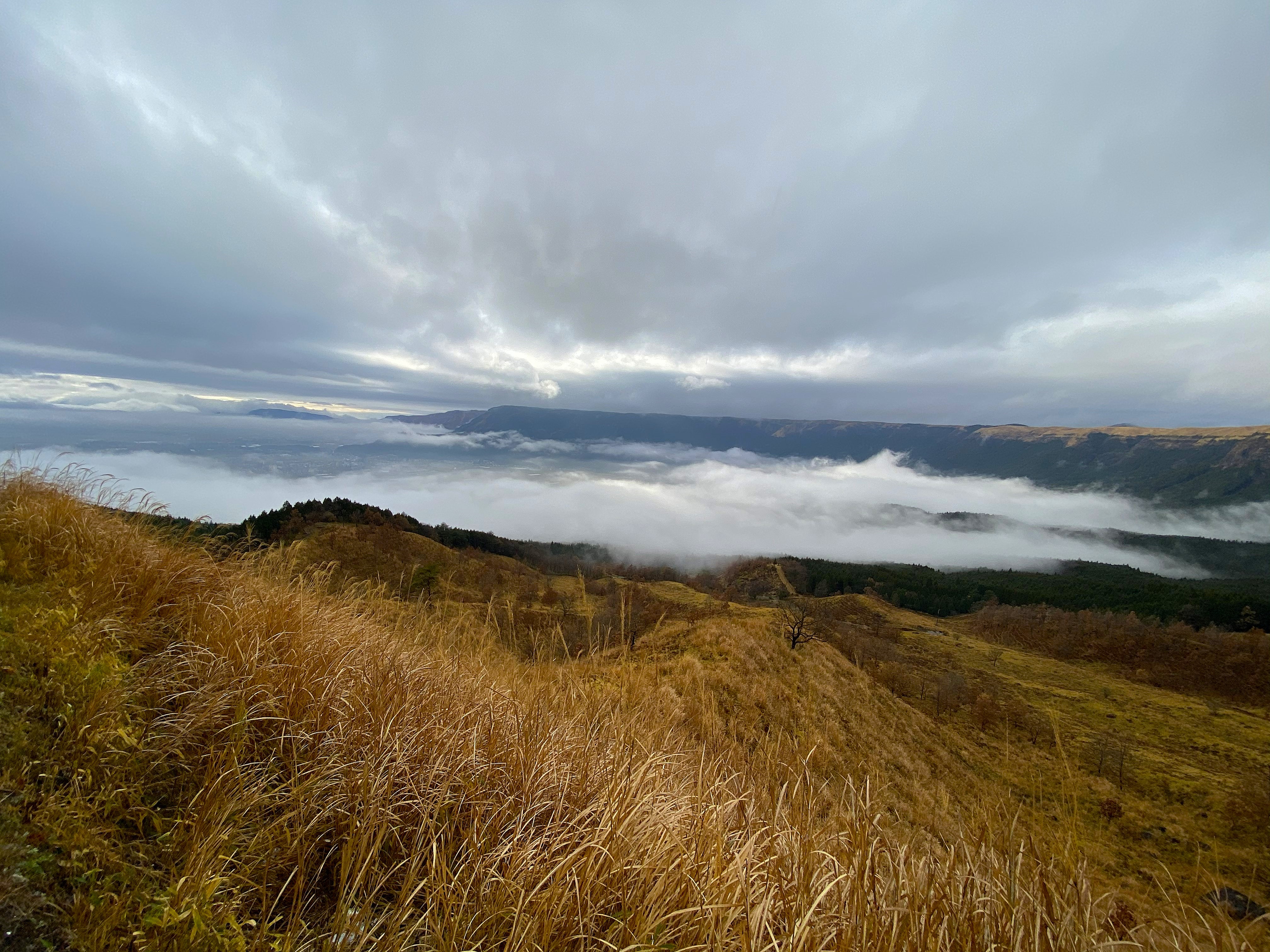
Aso City, sitting on the caldera floor below — the whole valley swallowed by cloud.
The drive down from the rim delivers its own views — sugi-lined roads with the volcano appearing and disappearing, the golden slope of the upper caldera walls, wet pavement and empty lanes on a cold December afternoon.
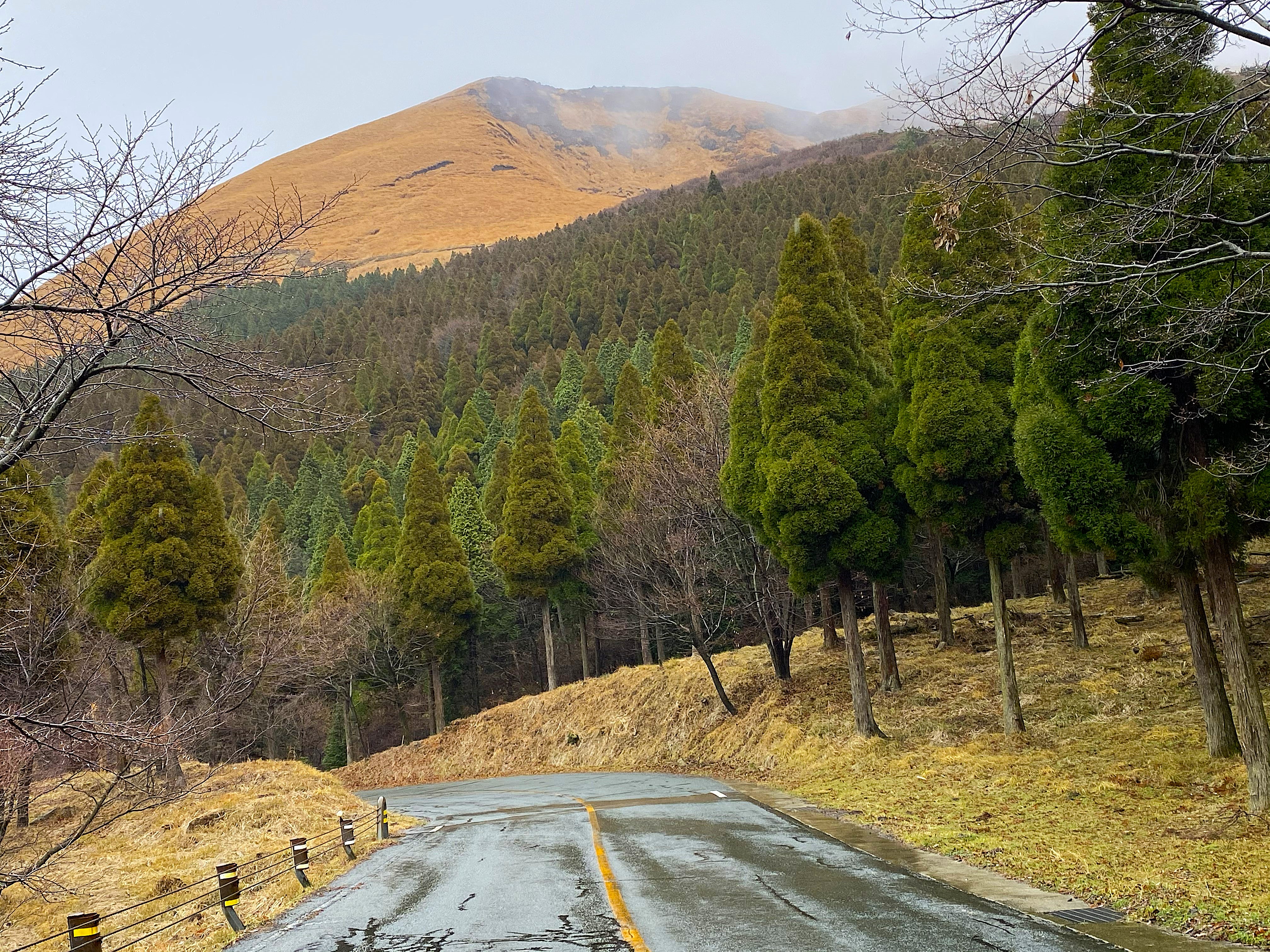
The sugi-lined descent from the caldera rim.
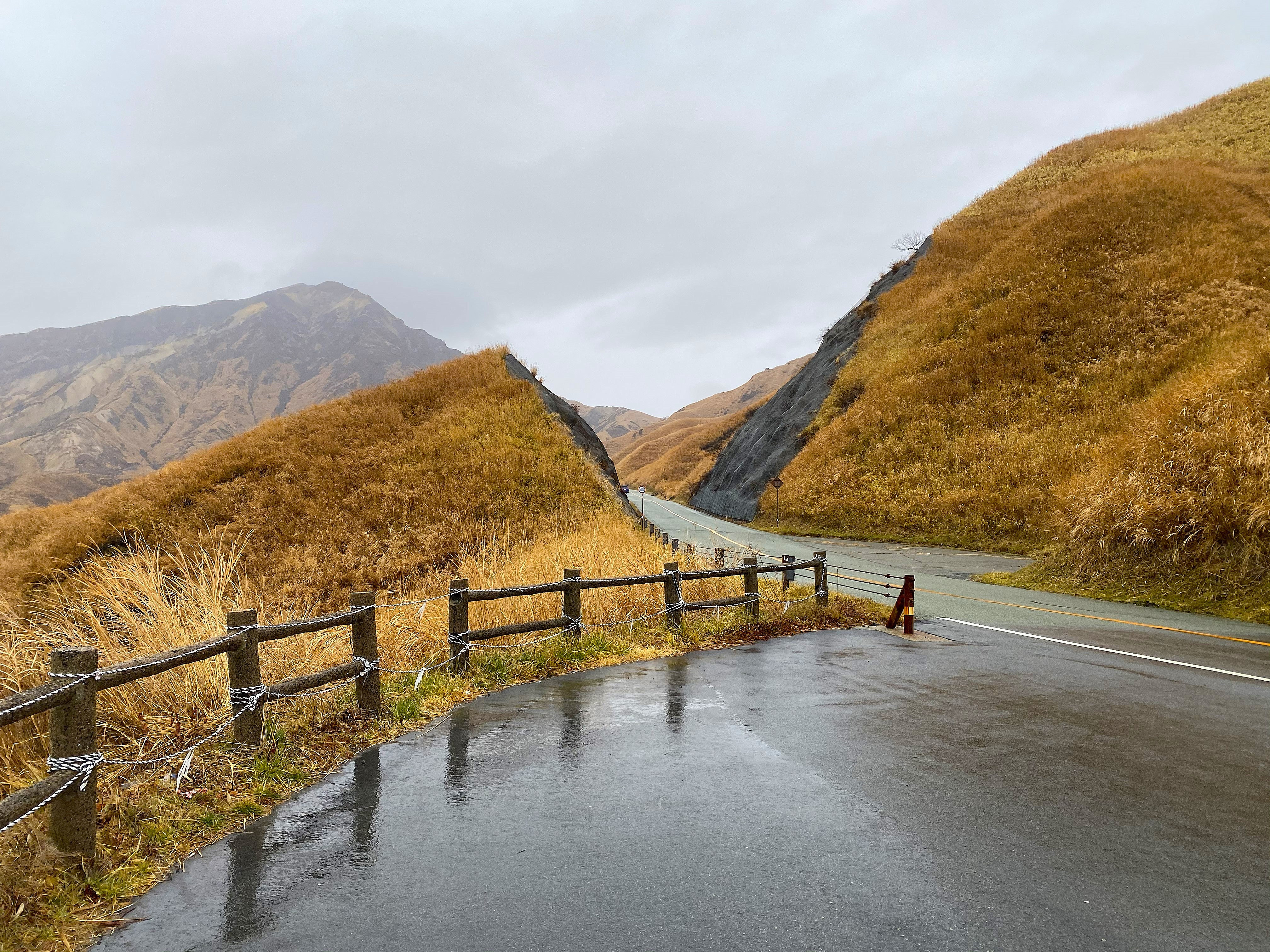
Heading toward Kurokawa. Golden hills on both sides, the road empty.
Jersey Soft Serve and a Roadside Surprise
We made a pit stop along the way. The Aso area is dairy country — Jersey cattle, rich milk — and the soft serve that comes from it is the kind of thing you stop for even in December. The cone was tall and cold, with that clean, full milk flavor that nothing else really matches.
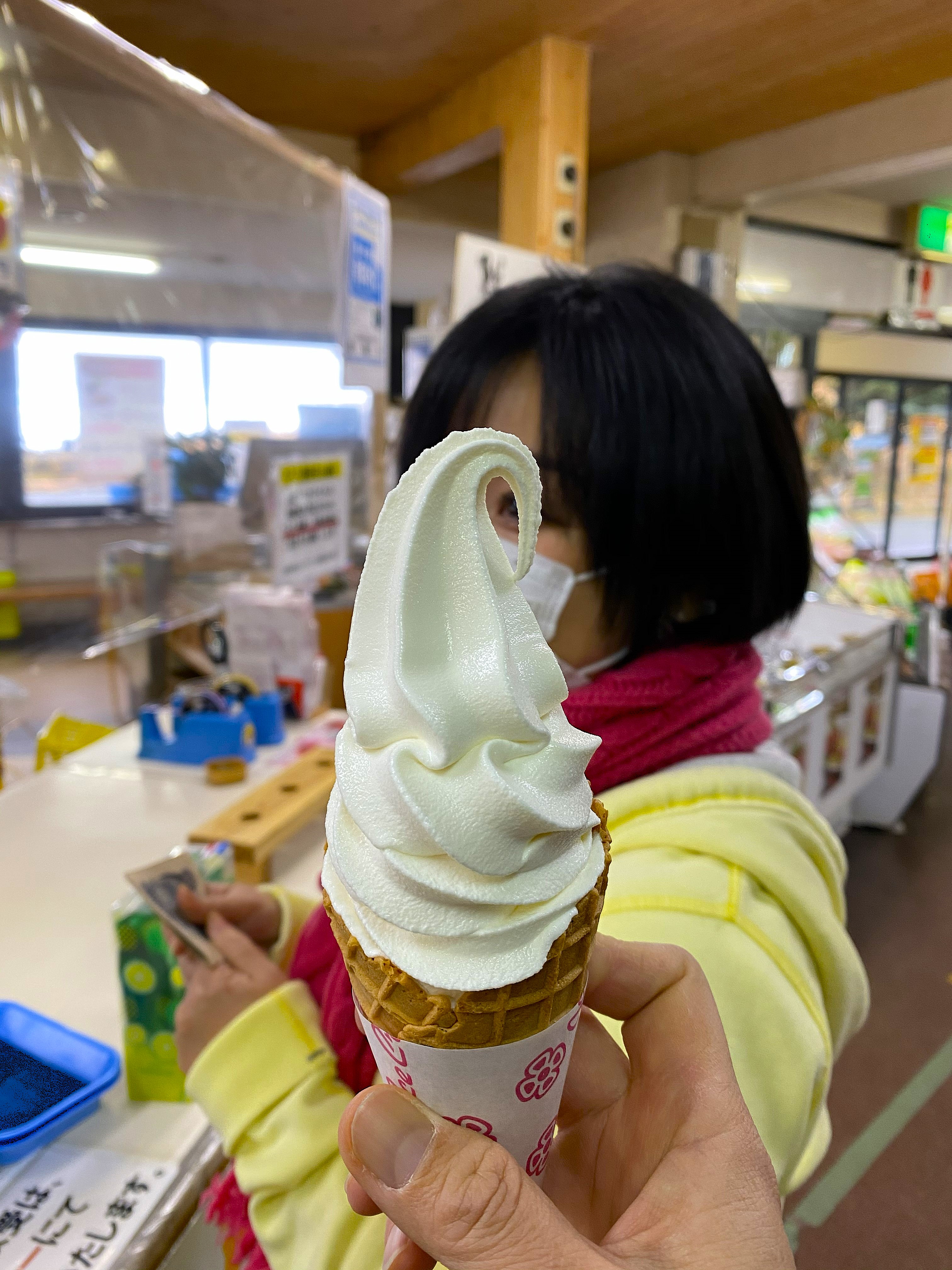
Jersey soft serve. The Aso region dairy farms produce some of the richest milk in Japan.
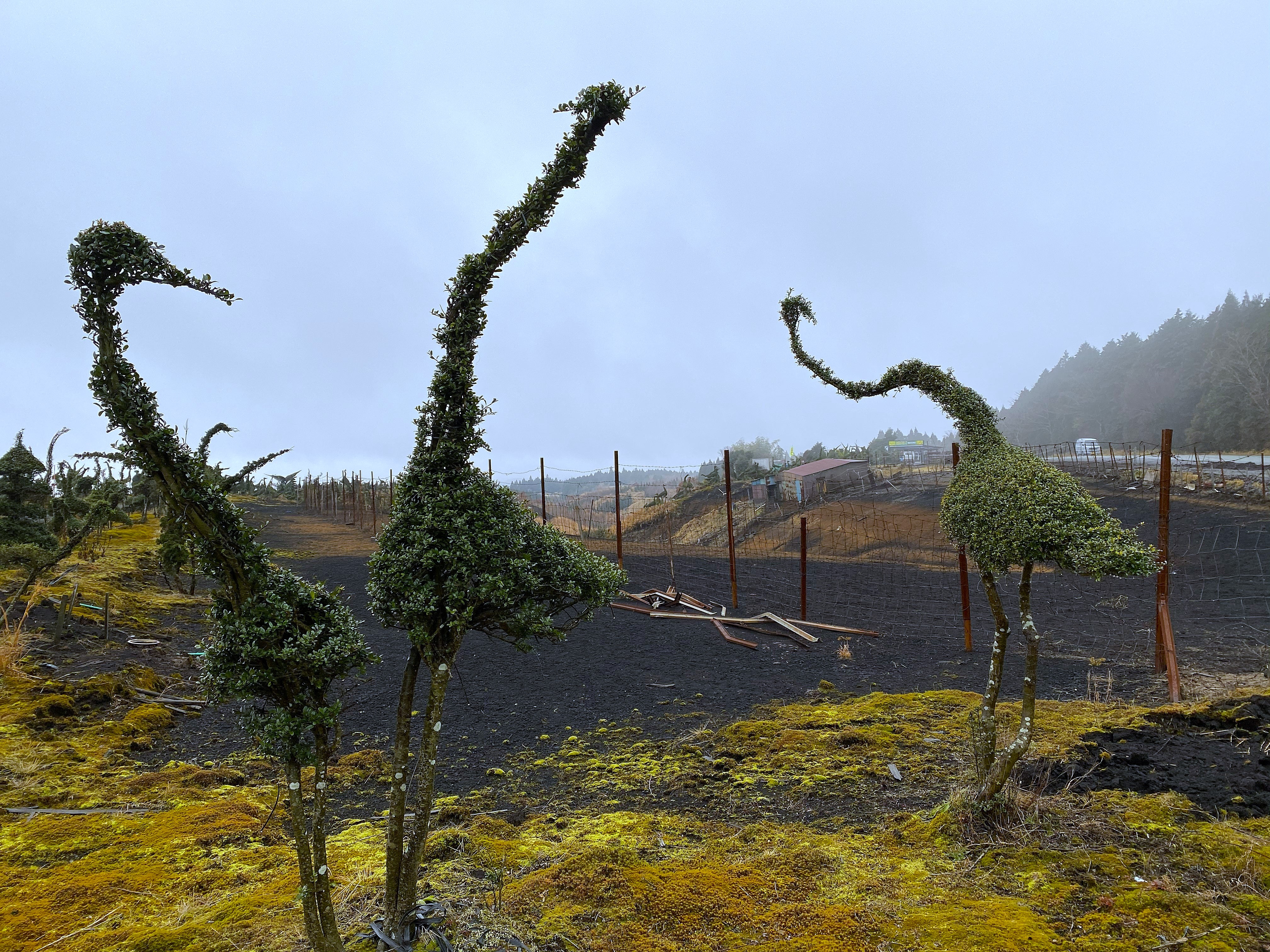
Somewhere between Aso and Kurokawa. No explanation provided.
Somewhere on the road between Aso and Kurokawa, there are topiary sculptures shaped into long-necked creatures standing on black volcanic soil. No signage, no context. Just the figures, the fog, the moss, and the silence. Japan does this — it places specific, strange, beautiful things in the middle of nowhere and lets you find them.
Kurokawa Onsen: 里の湯 和らく
Kurokawa Onsen is a small hot spring village in the mountains of northern Kumamoto — a collection of traditional ryokan set along a river gorge, each with its own character. 里の湯 和らく, Satonoyu Waraku, sits back from the main strip. We arrived in the late afternoon, the light already low.
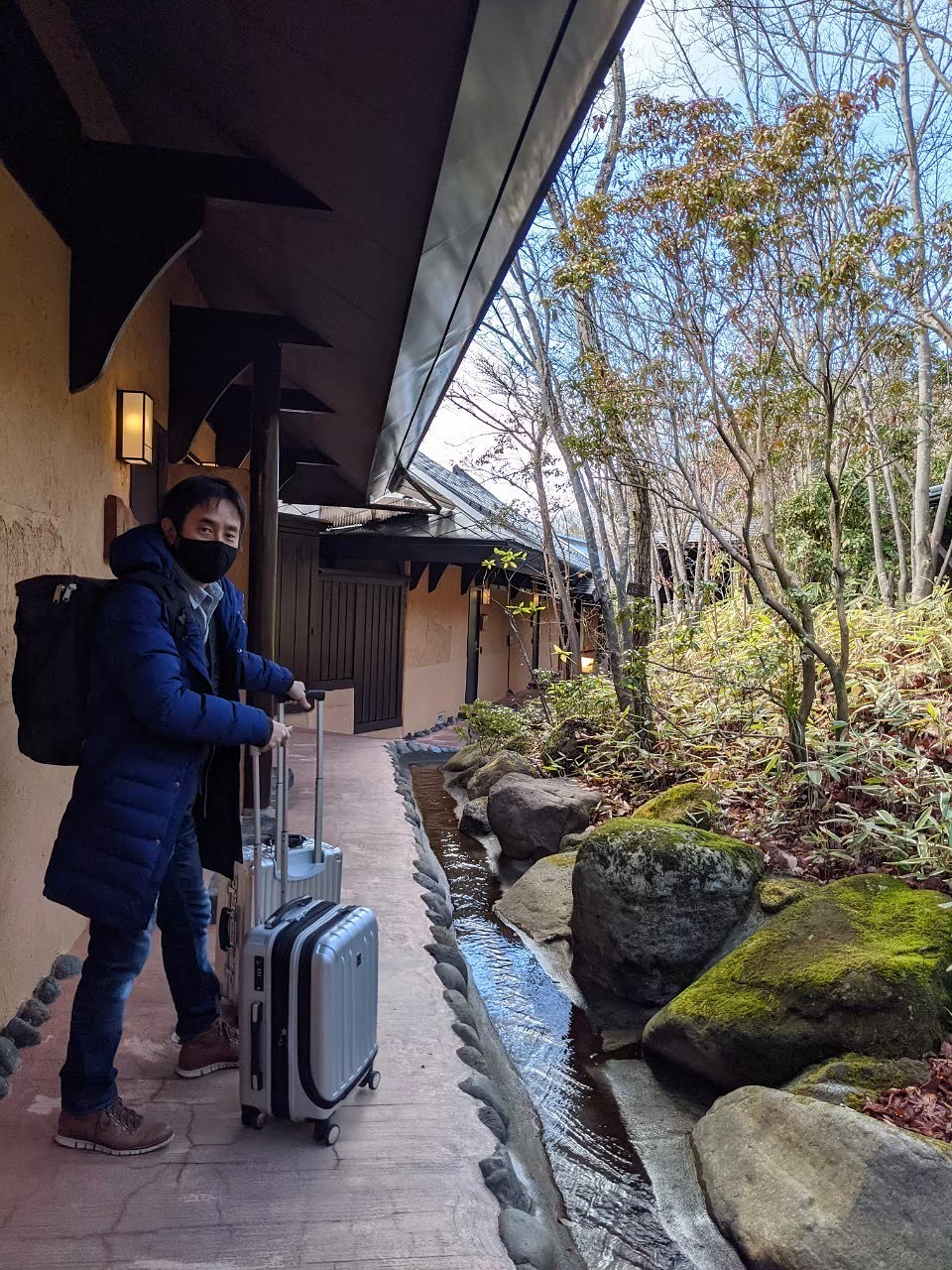
Checking into Waraku. A small stream runs alongside the entrance path.
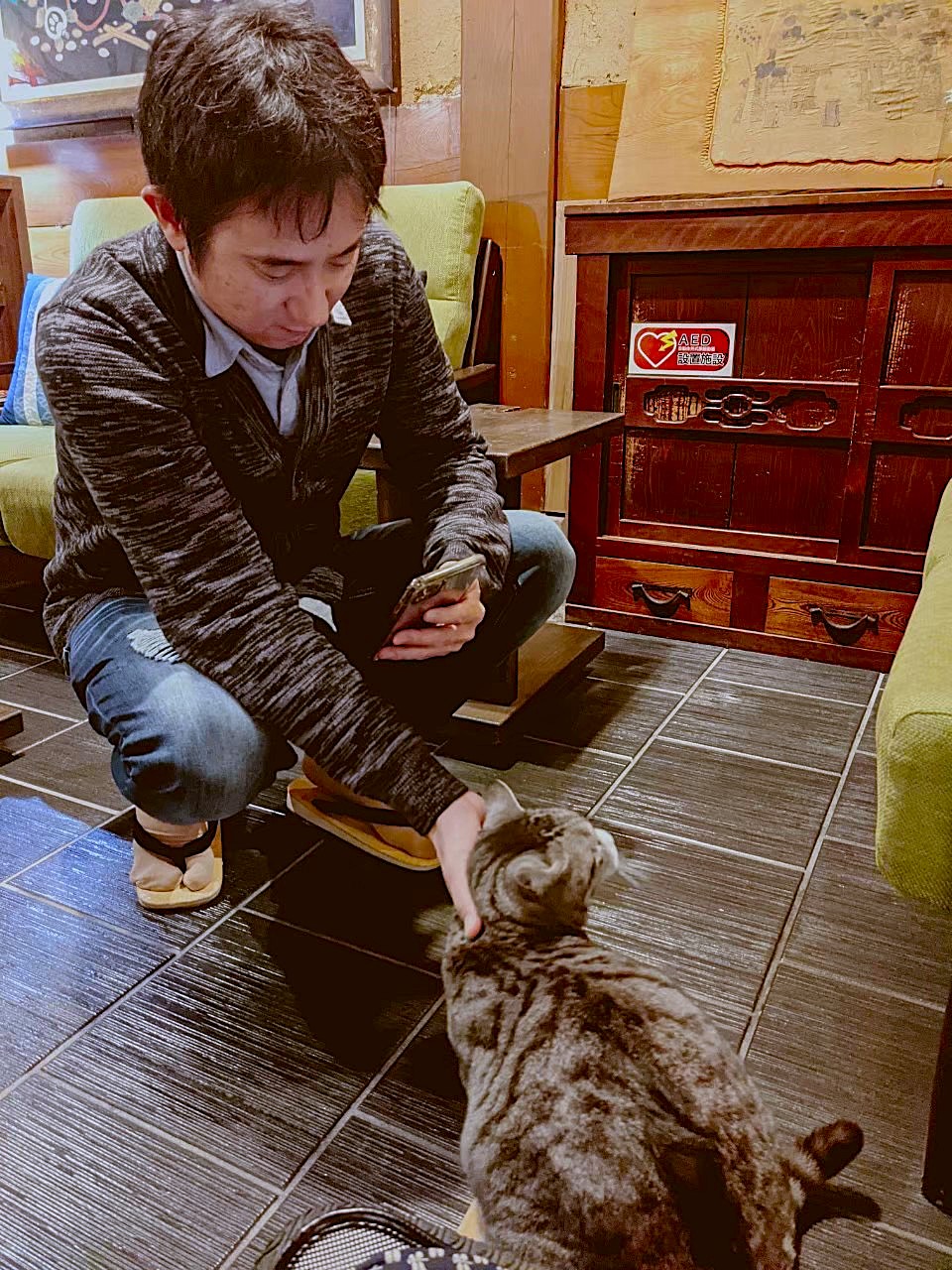
The welcome committee. The cat was more interested in being petted than in checking us in.
The Room
Our room was called 畦道 — Azemichi, the path between rice paddies. A tatami floor, futon laid out on the mat, sliding doors opening to a small engawa deck with a view of winter trees. An orange kerosene heater in the corner, which told you everything you needed to know about December nights in the mountains.
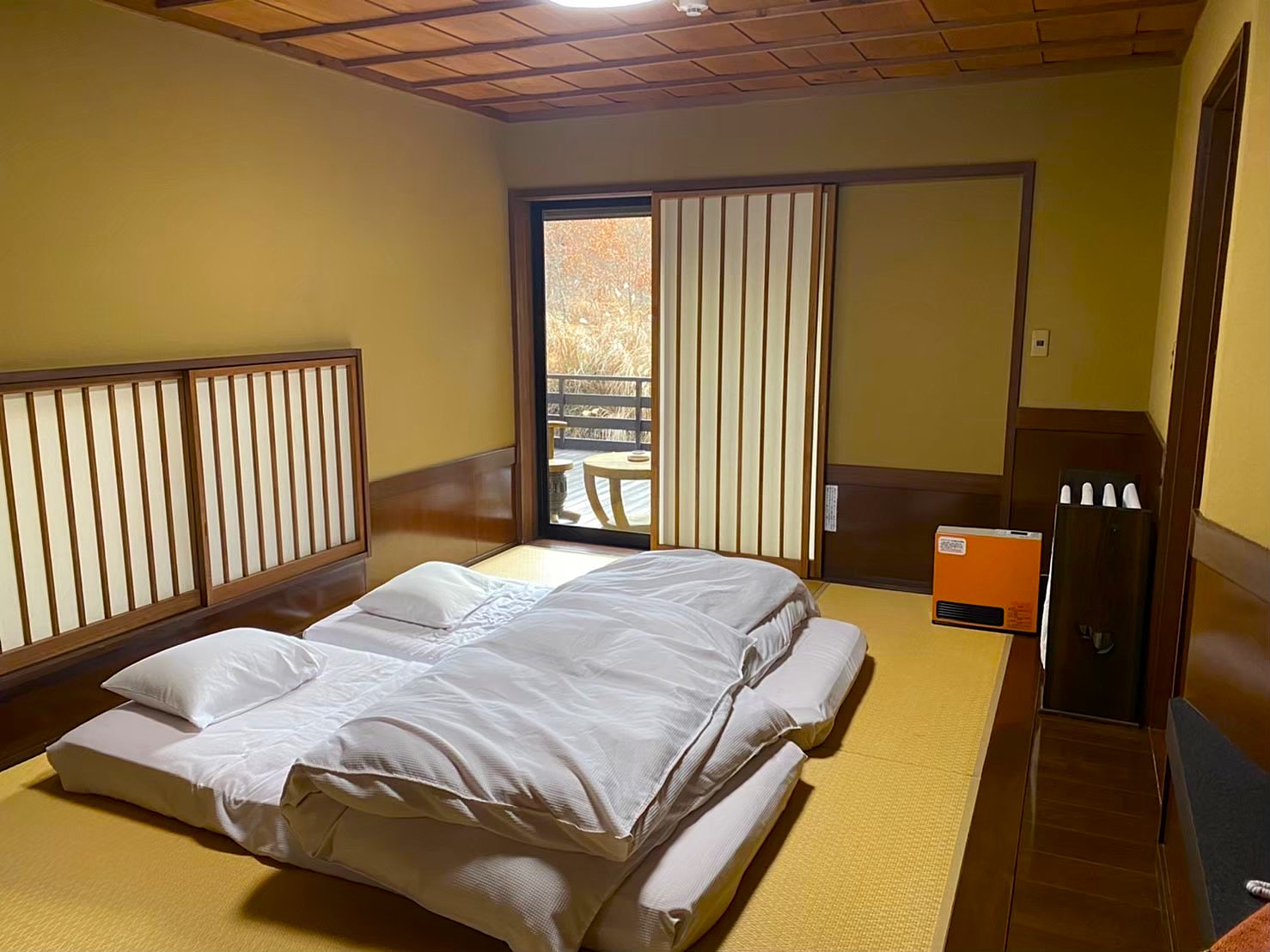
Room 畦道 — Azemichi. Tatami, futon, and an orange kerosene heater for cold December nights.
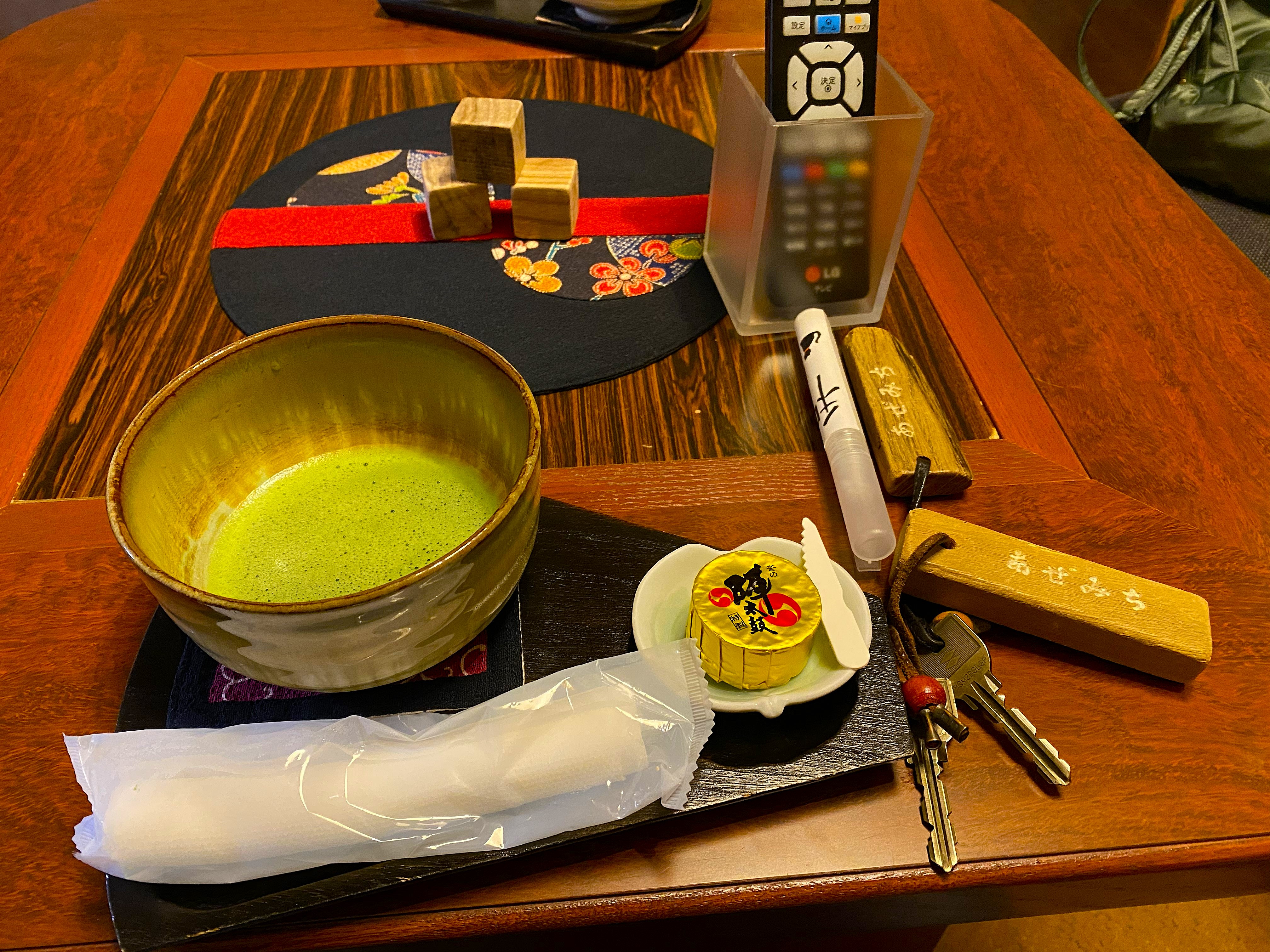
The welcome matcha and wagashi, laid out with the room key — the wooden fob reads あぜみち.
The Onsen
Kurokawa is known for its milky, sulfurous hot spring water — the kind that turns the bath pale blue-white and leaves your skin soft for hours. Waraku has private baths in addition to the shared baths on the property. On a December evening, getting into hot spring water after a day in the cold and the wet is not a luxury — it is a necessity.
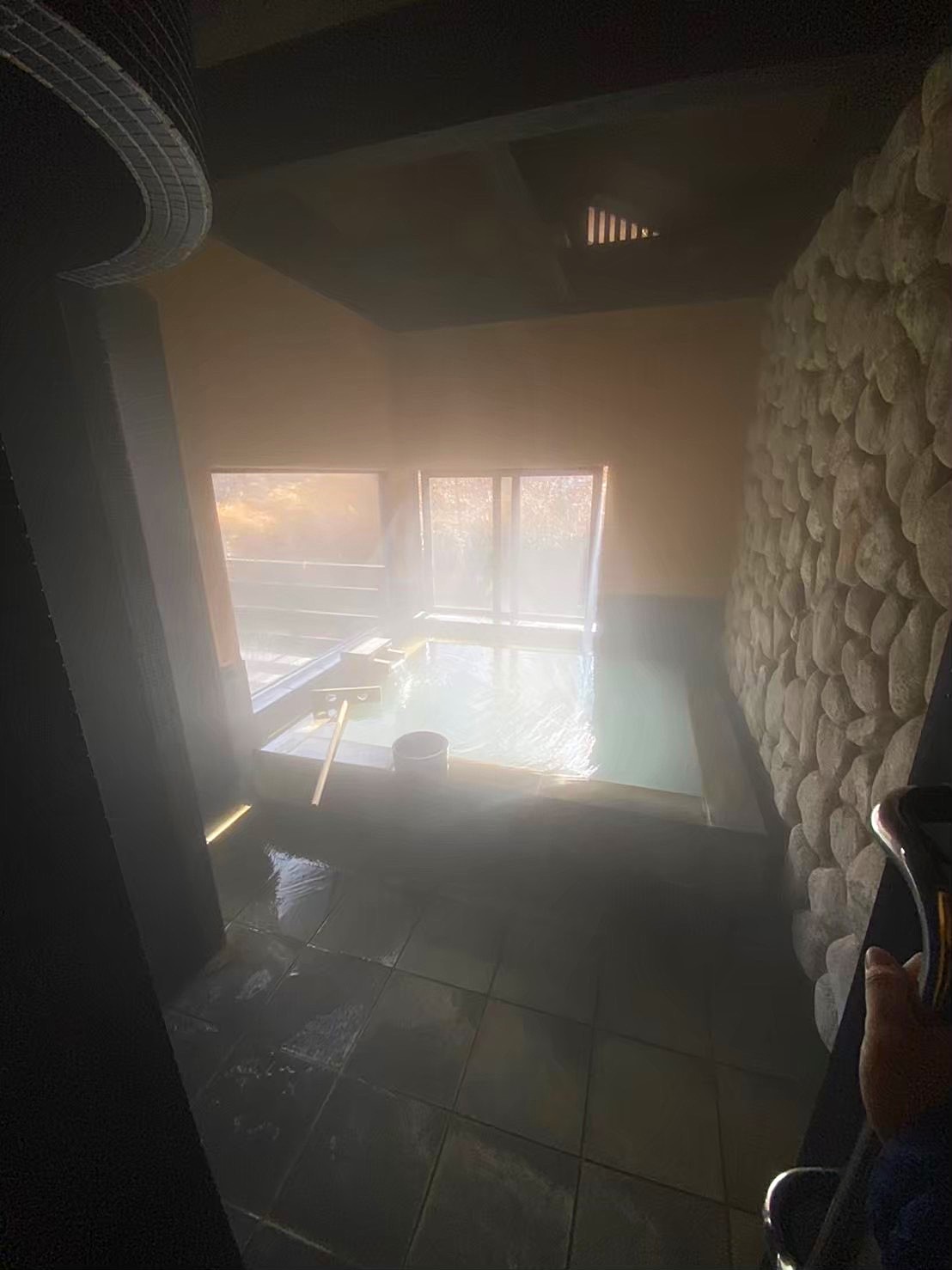
The in-room private onsen. Milky Kurokawa hot spring water, late afternoon steam.
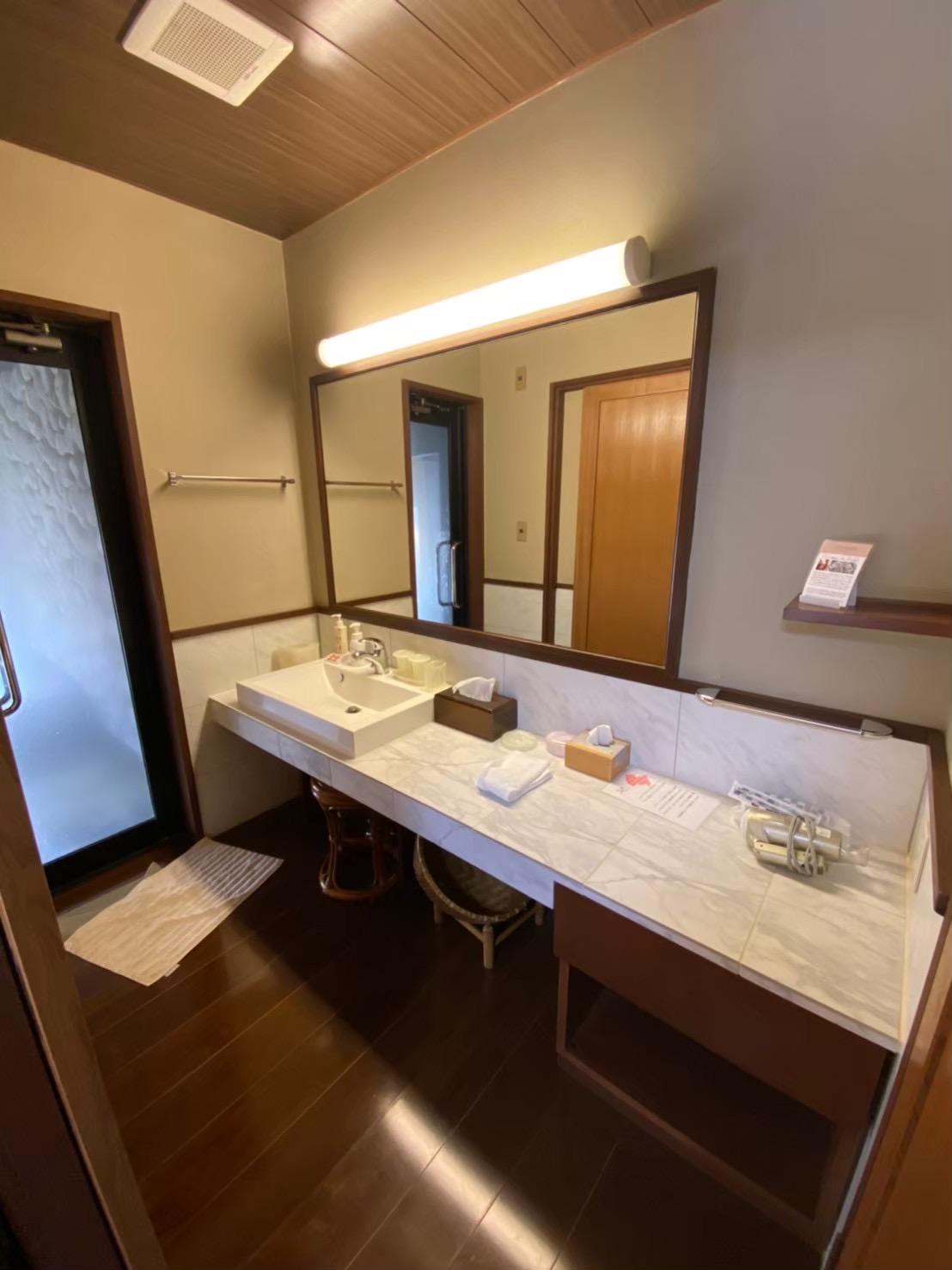
The dressing area adjacent to the bath. Cedar ceiling, marble counter, everything you need laid out.
Dinner
Kaiseki dinner at Waraku that evening was a full course set — the menu handwritten in brushstroke Japanese on a single sheet of paper. It opened with an Amaou strawberry frozen cocktail, then a tomato soup with celery root mousse, then a spread of appetizers: monkfish liver confit on a canapé, lamb bruschetta, ice plant with balsamic, gold kiwi and duck marinade. The plates kept coming.
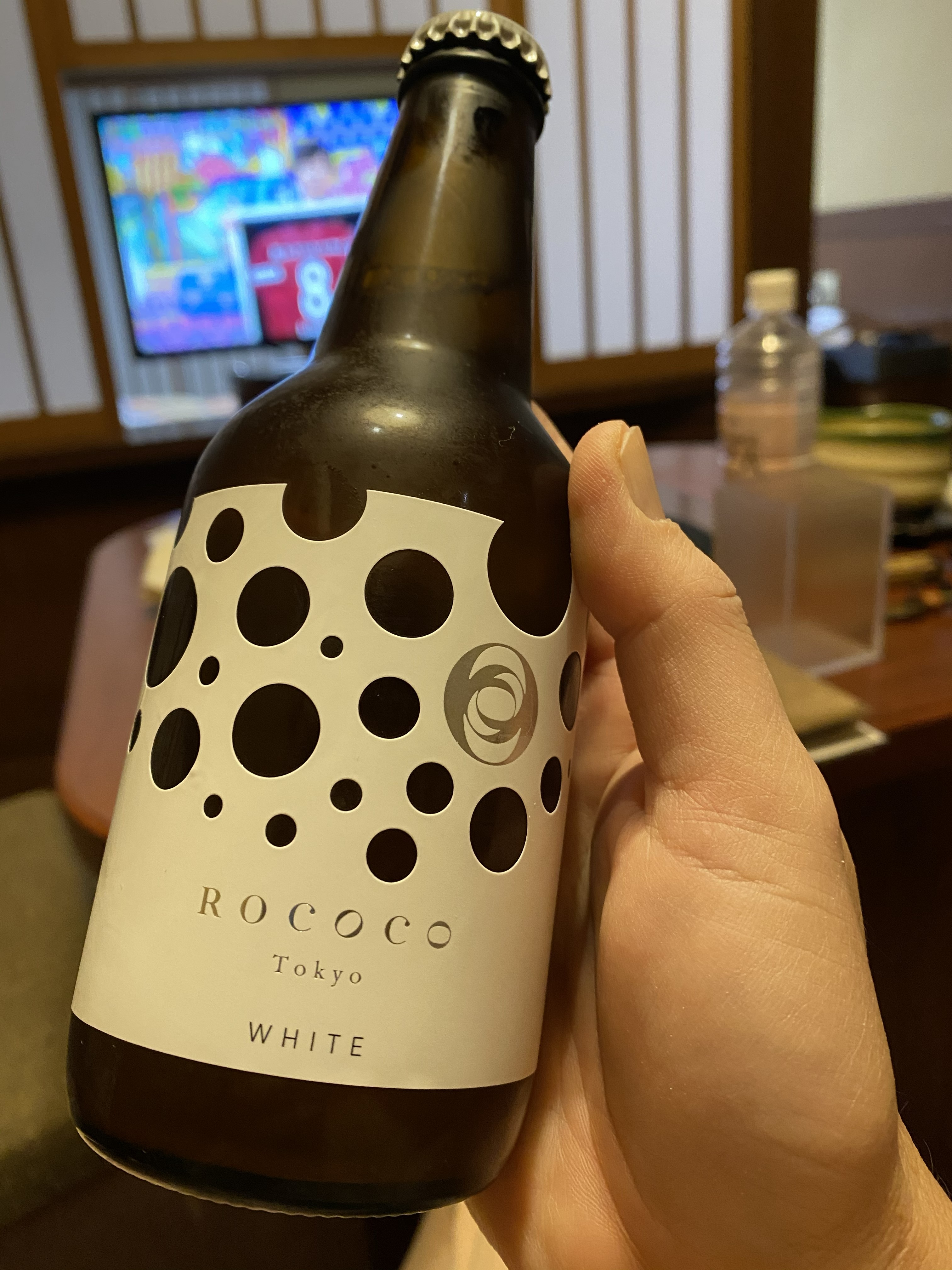
Ayumi's pick for the evening — ROCOCO Tokyo White, the featured craft drink at Waraku.
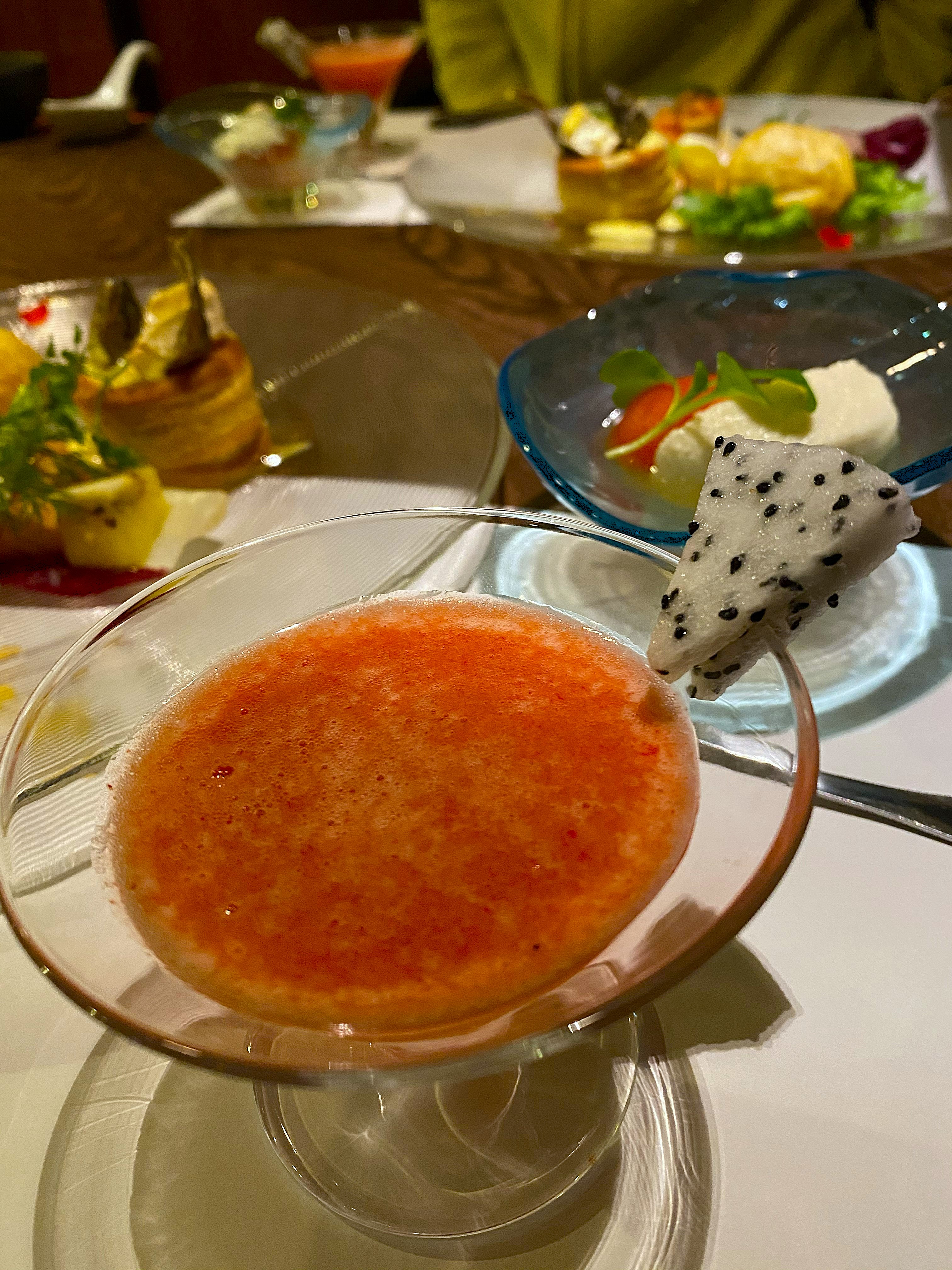
The opening spread. Tomato soup in the foreground, the appetizer array taking up the rest of the table.
The sashimi course came on a long narrow plate painted with a Japanese white-eye bird perched on plum blossoms — suzuki, tako, and kue, arranged with a cylinder of daikon julienne and fresh wasabi.
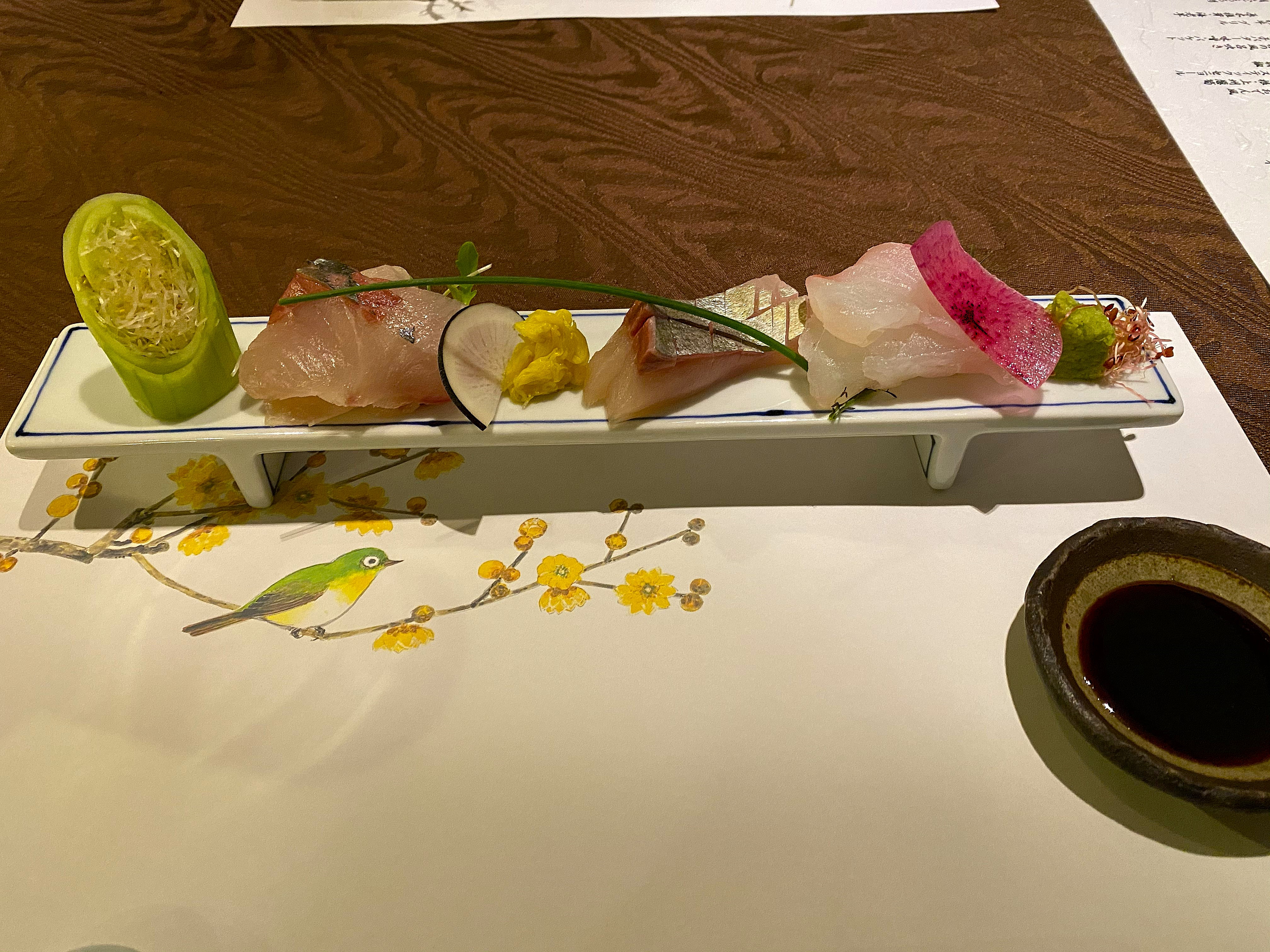
The sashimi course. Suzuki, tako, and kue — on a plate that deserves its own mention.
The nabe course arrived in individual donabe pots, each set on its own burner. Lid on, flame burning underneath, the ceramic already hot to the touch. Inside: wagyu and winter vegetables in broth — daikon, mushrooms, greens — everything slow-simmered and deeply warm in the way only a proper nabe manages on a cold night.
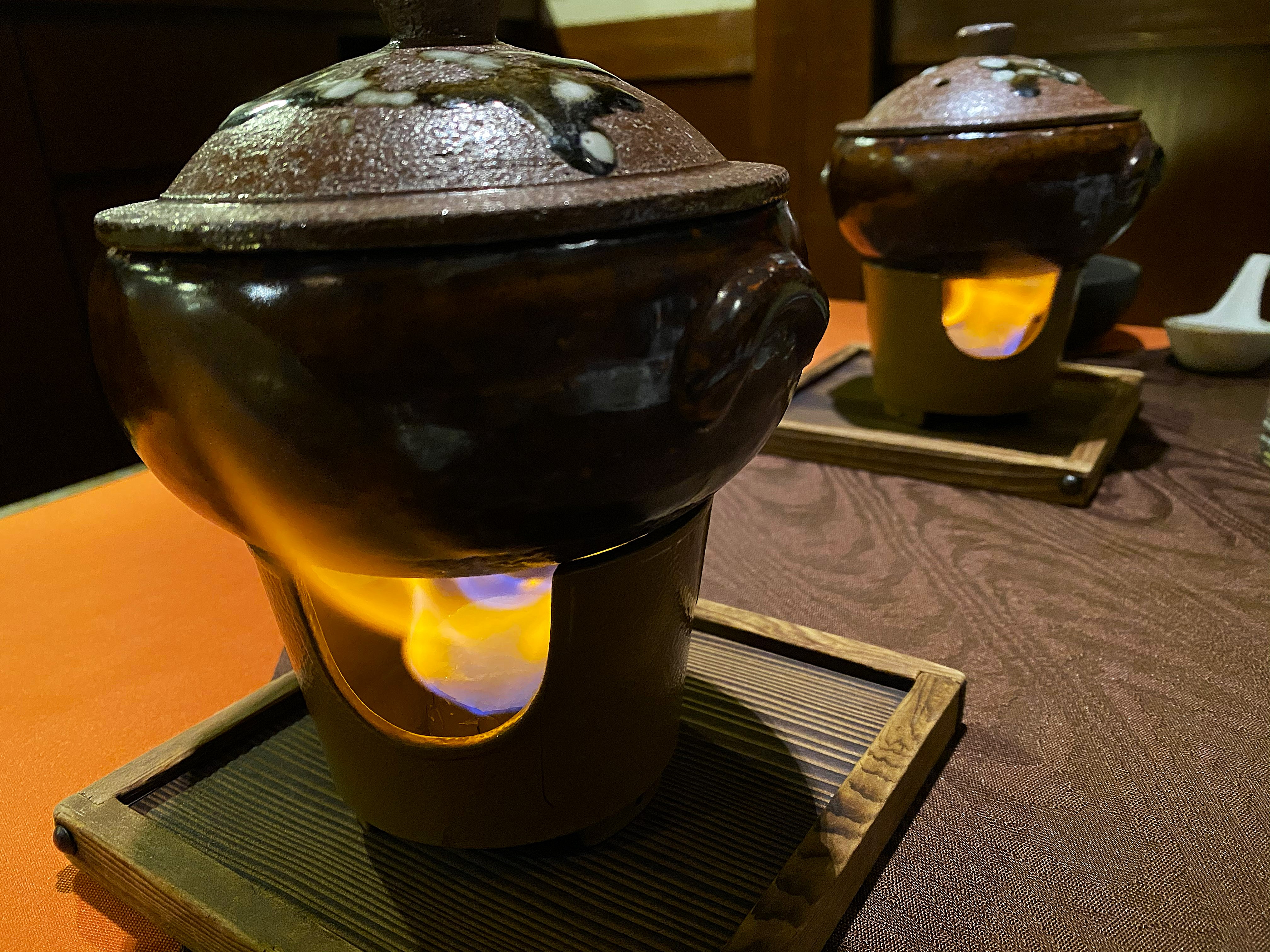
The nabe course arriving. Individual donabe for each of us, flame already lit underneath.

Inside the donabe — wagyu and winter vegetables in broth.
The grilled course was the standout — cubed wagyu from the Kumamoto region, deep mahogany from the grill, served simply with roasted lotus root and turnip. No sauce needed.
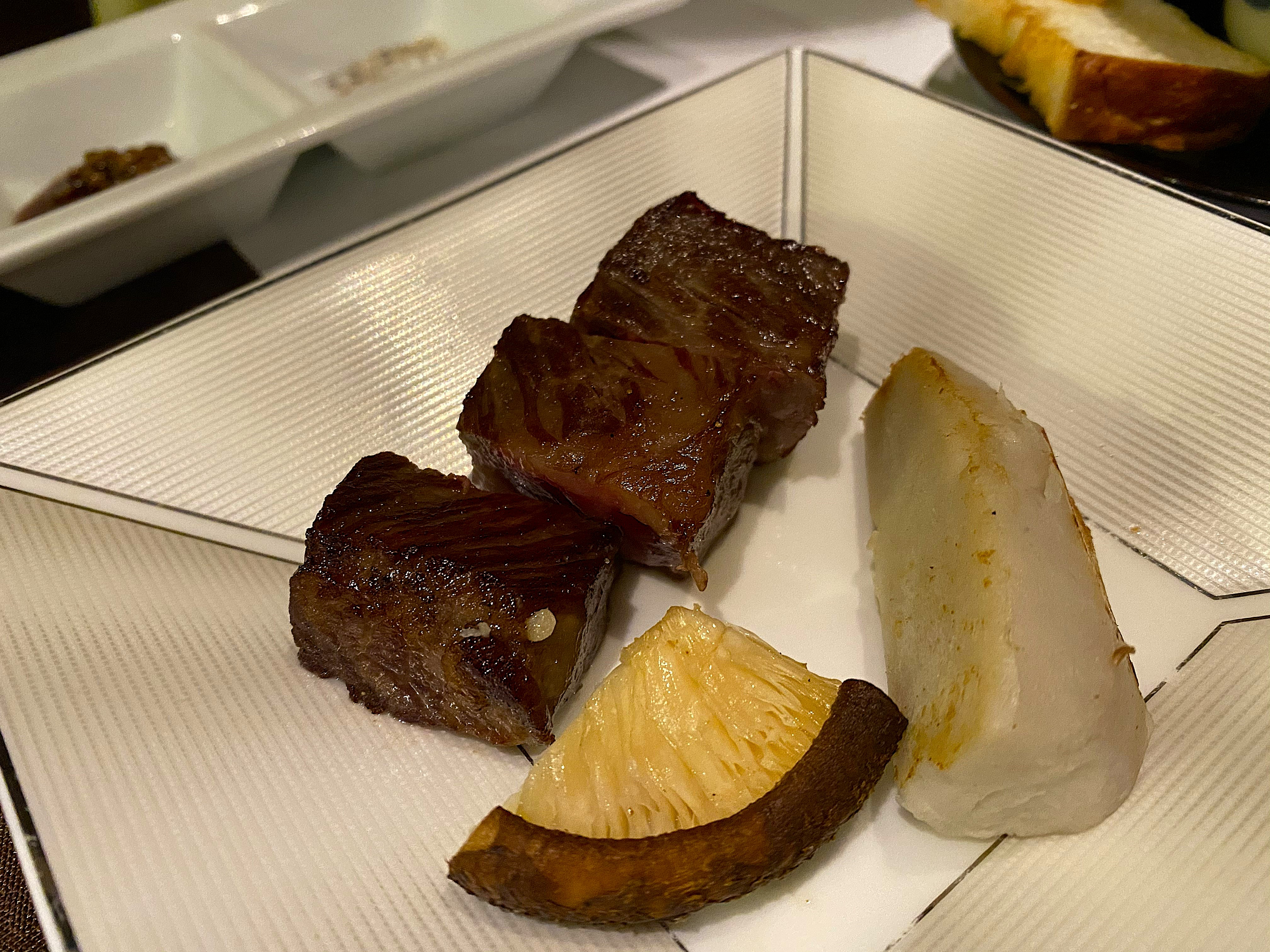
Grilled wagyu. Kumamoto beef, simply done — lotus root and turnip alongside.
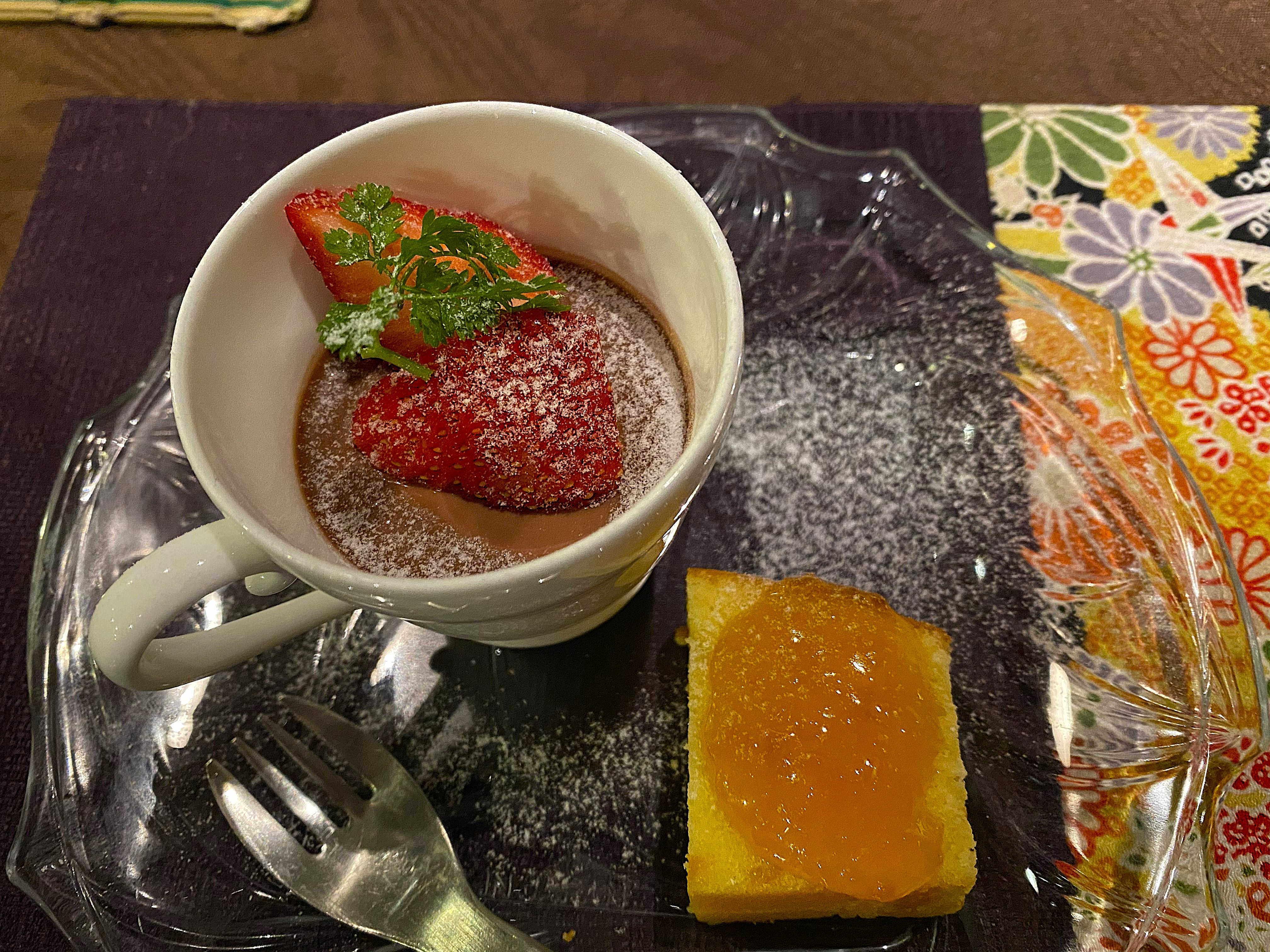
Dessert: chocolate mousse with Amaou strawberries, and a slice of Shiranuhi citrus pound cake.
Dinner ran close to two hours. By the time we were done the temperature outside had dropped considerably, the sulfur smell from the hot springs was stronger, and the village was completely quiet. Part 2 picks up from the next morning.
Location: Takamori-machi, Aso-gun, Kumamoto Prefecture. About 50 minutes from Kumamoto Airport by car.
Admission: Free. Open grounds.
Best time: Weekday, off-season. The shrine is well-known and weekends draw crowds. Early morning is quietest.
Footwear: The path to the cave shrine is uneven and muddy in wet weather. Good shoes matter.
Pair with: Kurokawa Onsen is 30–40 minutes north by car — a natural overnight stop.
Location: Kurokawa Onsen, Minami-Oguni-machi, Aso-gun, Kumamoto Prefecture.
Getting there: By car from the shrine, roughly 30–40 minutes north via the Aso caldera road. The drive is part of the experience — plan a stop at the Aso caldera viewpoint.
What it is: A traditional ryokan with private and shared hot spring baths, full kaiseki dinner, and in-room futon. Our room was 畦道 (Azemichi). Dinner on December 24th ran for close to two hours.
The onsen: Kurokawa is known for its milky, sulfurous hot spring water — sodium bicarbonate springs. Private baths available in addition to the shared rotenburo on the property.