We wanted to see some nature, but we were tired and didn't want to go far. We landed on a place we'd never been, mostly because we liked the name: Hatonosu — the pigeon's nest. It turned out to be a green river gorge an easy ride west of the city, and it was exactly what we needed.
We love Takao-san — that's a story for another day — but the night before, John asked Ayumi if she'd ever been out to Okutama, the mountainous western edge of Tokyo. Neither of us had. So we did some very light research, picked Hatonosu mostly on the strength of its name, and set out the next morning without much idea of what was actually there.
Getting there is half the fun of it. We took the Seibu Shinjuku line out to Haijima, transferred to the JR Ome line, and hopped on a special rapid — which we promptly rode all the way to the end of the line at Okutama Station before realizing we'd overshot. So we reversed and came back a couple of stops to Hatonosu. No harm done; the whole valley is worth seeing twice.
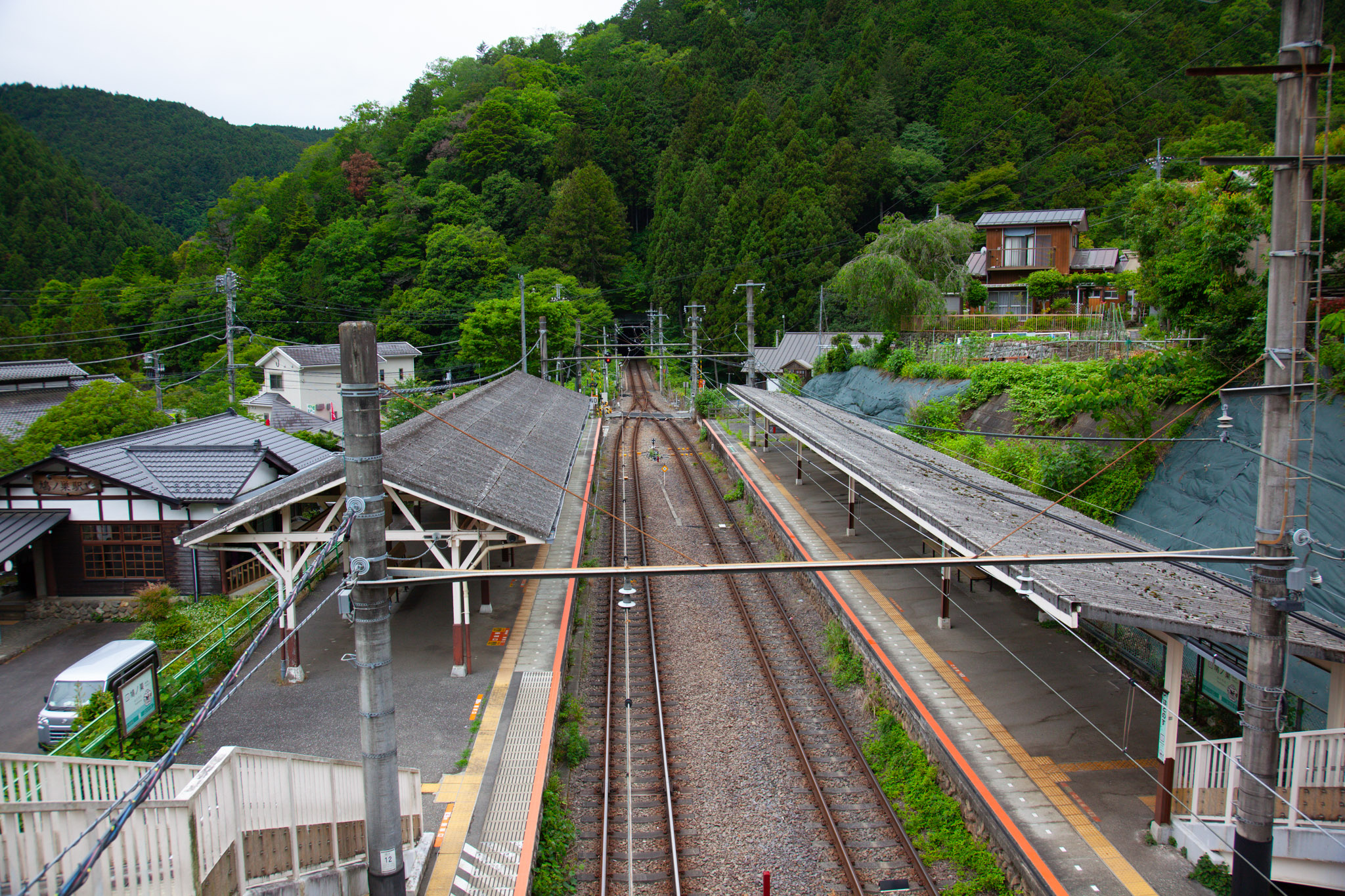
Hatonosu Station from the footbridge. Two tracks, a tiled roof, and mountains on every side. Still technically Tokyo.
Hatonosu (鳩ノ巣) is a tiny station deep in Okutama — a single platform, a lone IC card reader at the foot of the stairs, and not much else. From here it's a short walk downhill toward the Tama River and the gorge.
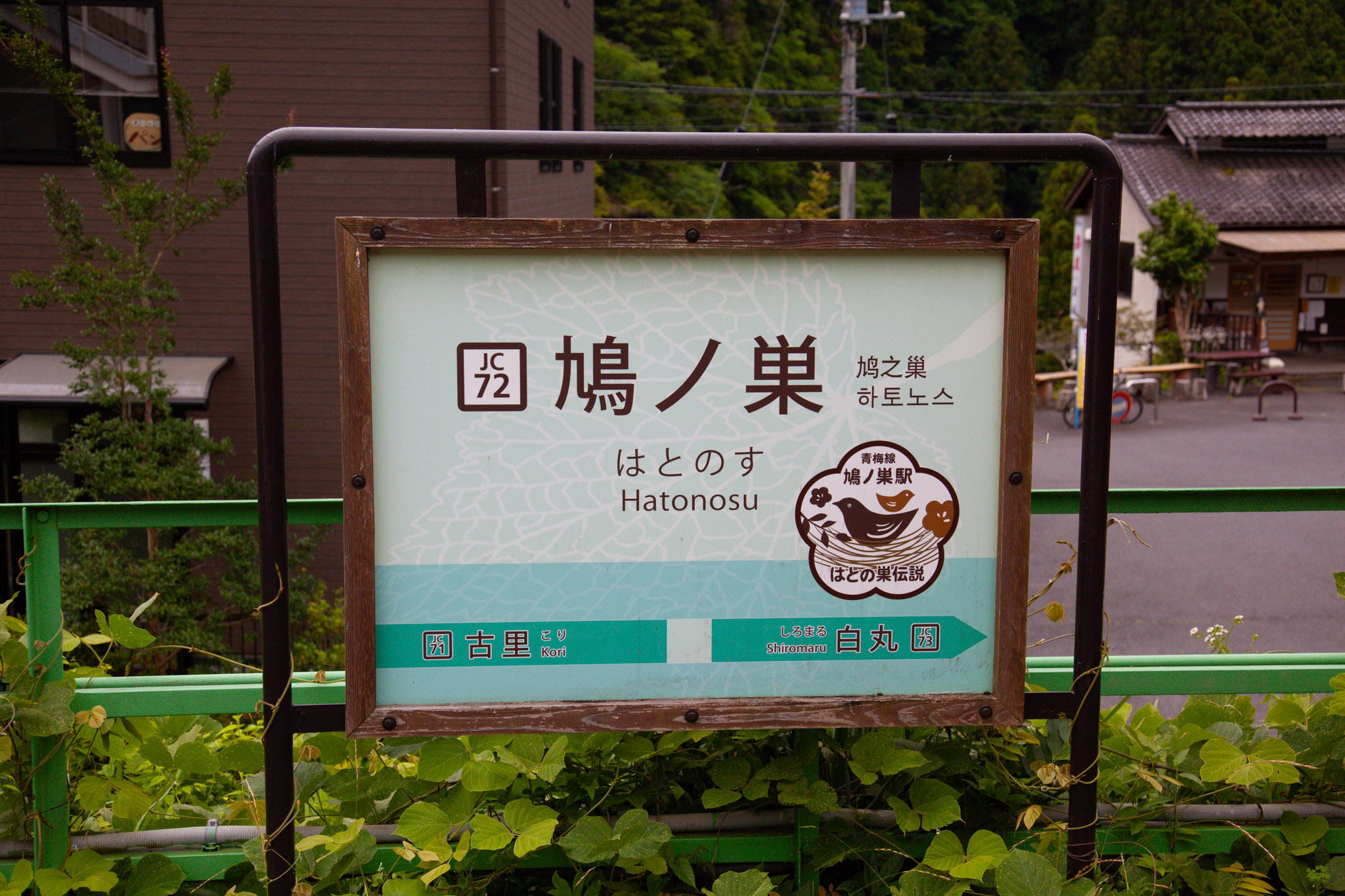
鳩ノ巣 — Hatonosu. JC72 on the Ome Line. Okutama, the end of the line, is just a few stops further (we know).
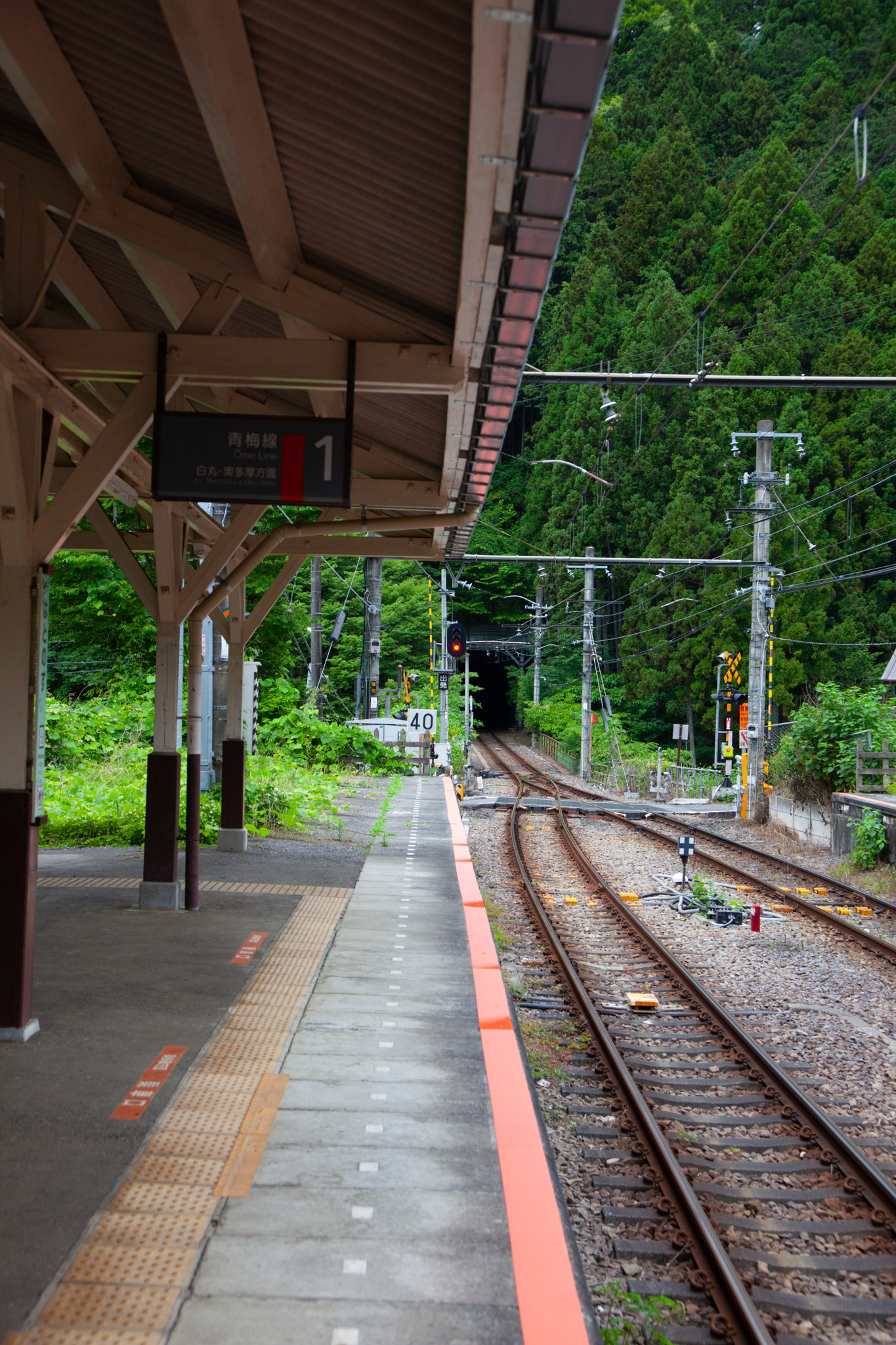
Platform 1, and not much else. The track disappears straight into the mountain.
Where the Name Comes From
"Pigeon's nest" turns out to be a literal name with a surprisingly specific origin, spelled out on a stone marker by the gorge. In 1657, the Great Fire of Meireki — the "Furisode Fire," named for the long-sleeved kimono said to have started it — burned through much of Edo. To rebuild the city and repair Edo Castle, the shogunate sent for timber from these very mountains: Hikawa, Nippara, Tabayama. The logs were cut and floated down the Tama River, and laborers' camps were set up along the banks to manage the drive.
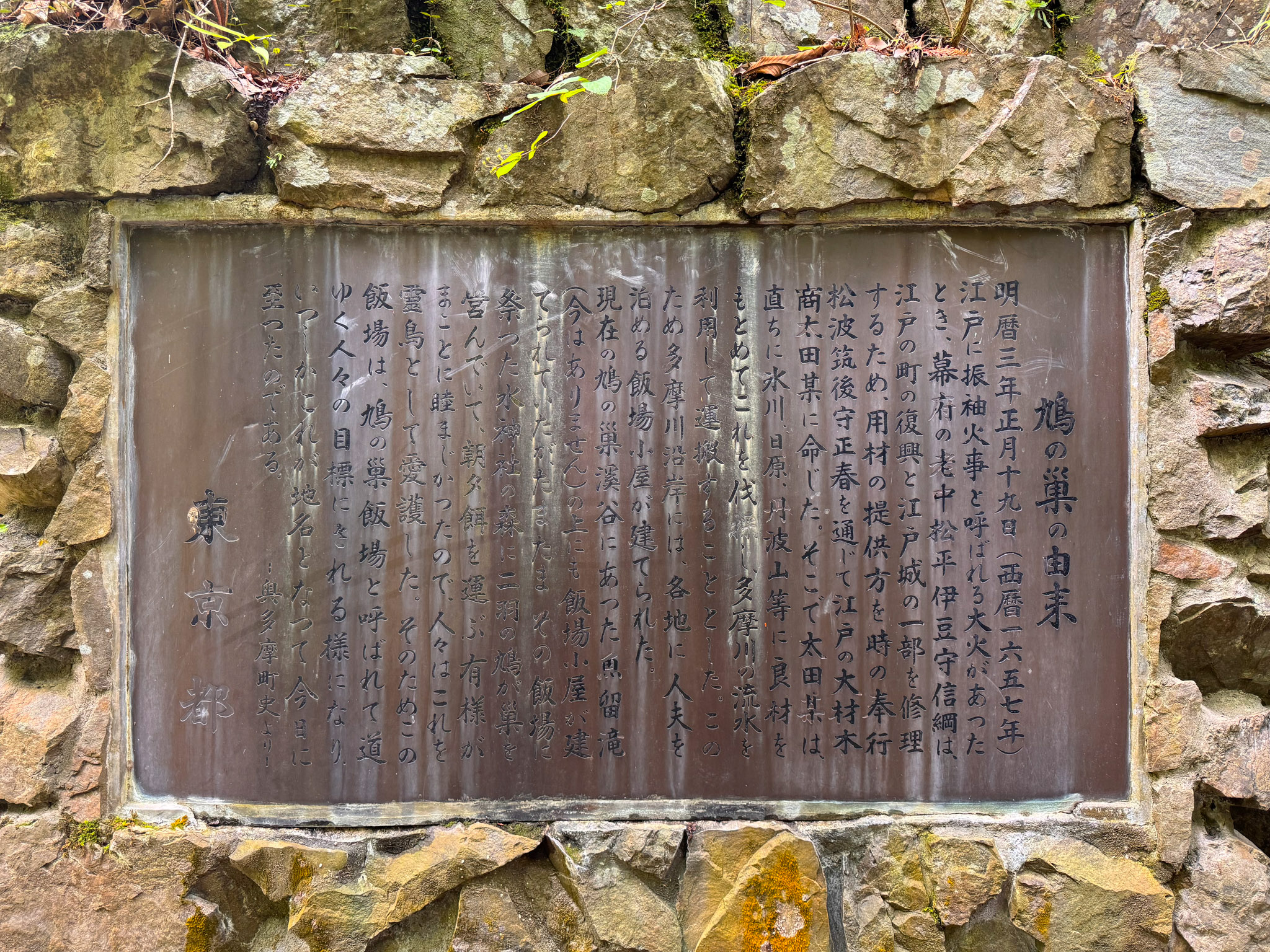
The marker at the gorge — 鳩の巣の由来, "The Origin of Hatonosu." The whole story is right there, if you can read it.
At the camp here, a pair of pigeons built a nest in the grove of the little water-god shrine, and tended it so devotedly — back and forth with food, morning and evening — that the workers took to protecting them as sacred birds. The camp became known as the Hatonosu, the "pigeon's-nest," camp; it turned into a landmark for travelers on the road, and the name eventually settled over the whole place. Three and a half centuries later, two pigeons are still the reason this station has its name.
Into the Gorge
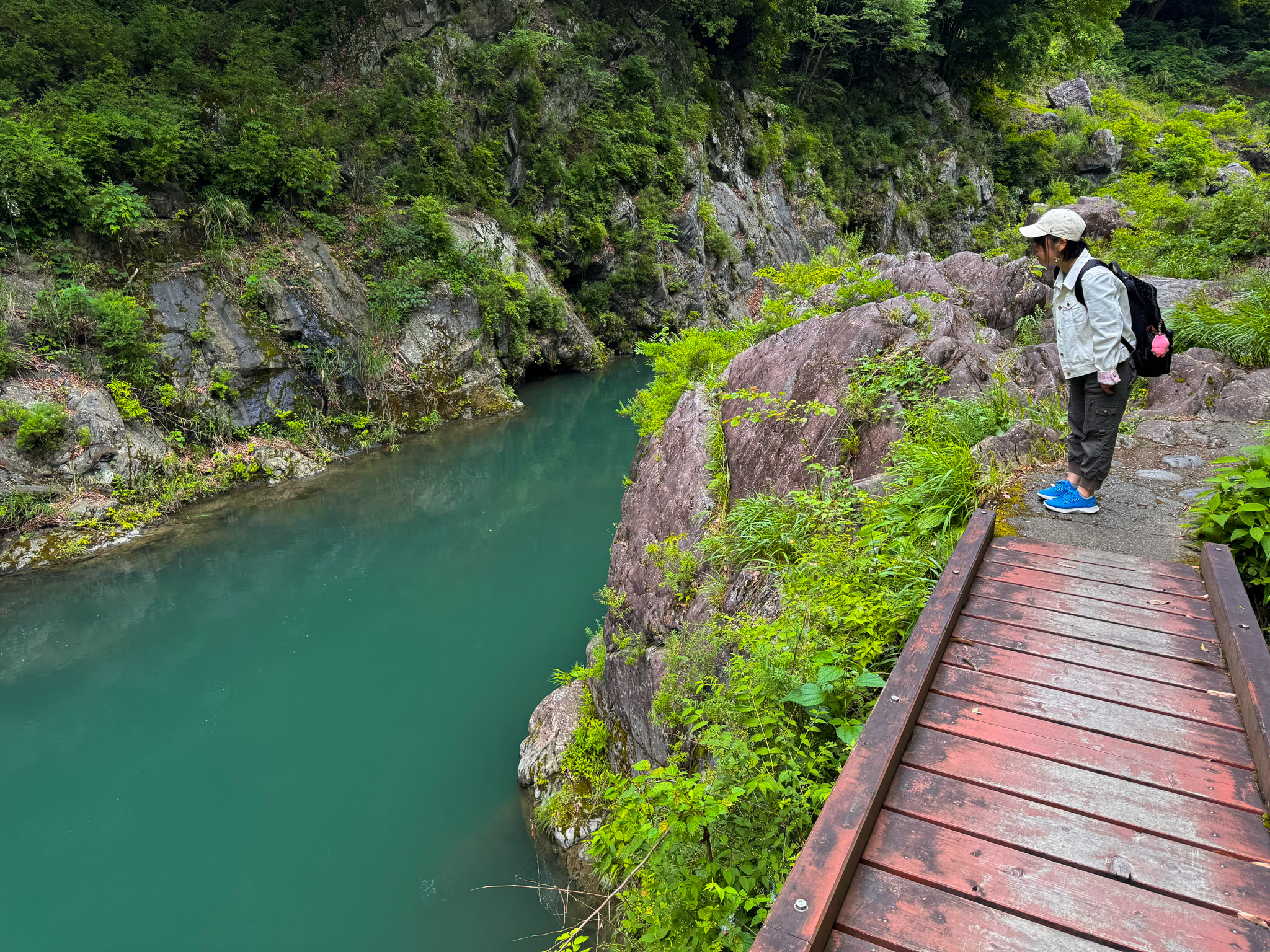
Hatonosu Gorge (鳩ノ巣渓谷, Hatonosu Keikoku) is a stretch of the upper Tama River where the water has cut down through the rock into a narrow green canyon. A walking path follows the river between Hatonosu and the neighboring Shiromaru station, threading along the bank, over footbridges, and past a few small shrines and waterfalls.
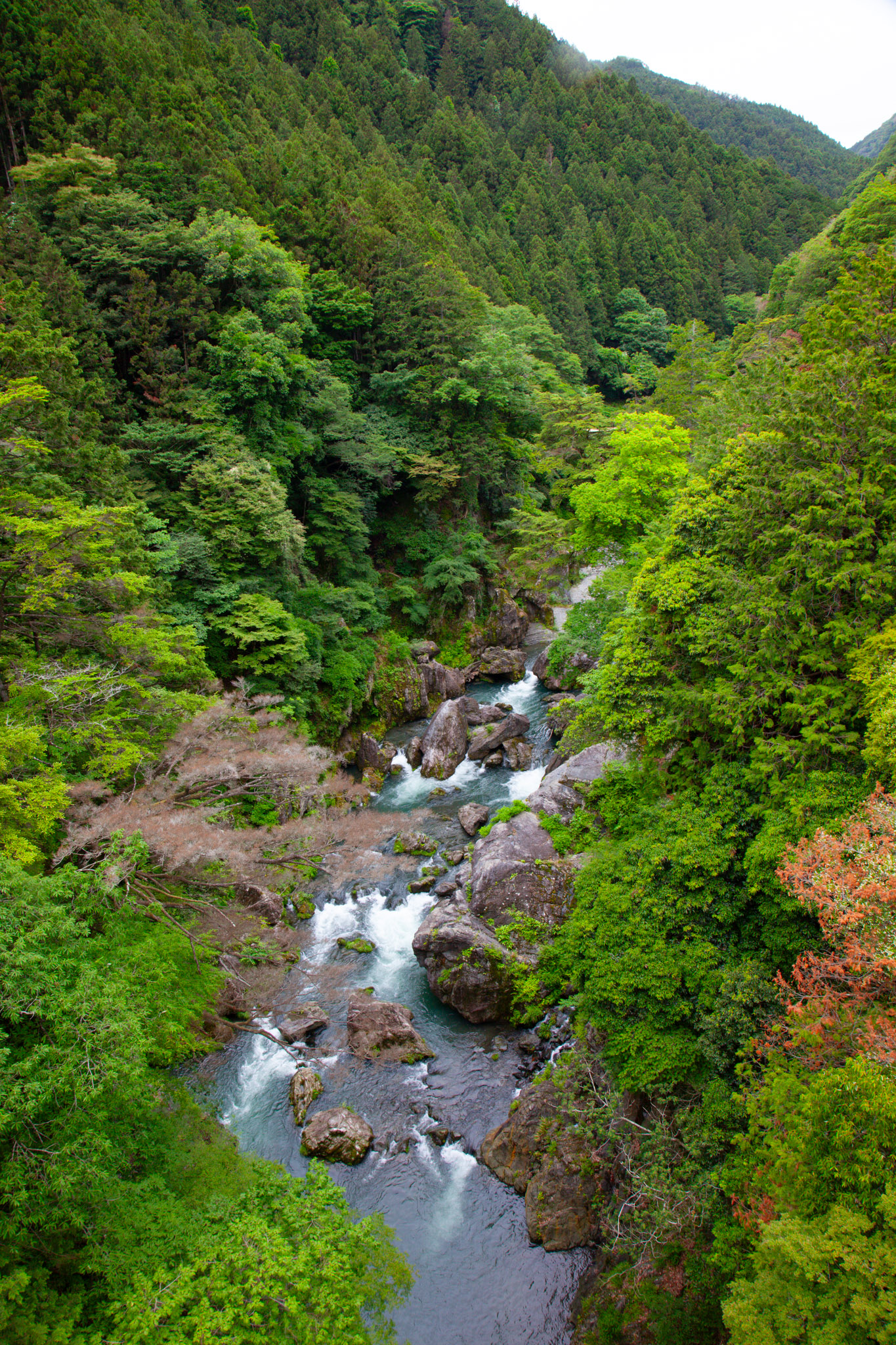
The Tama River working its way down through the gorge. In June it's all green except for one maple that didn't get the memo.
The thing that gets you is the color of the water. Where the river slows and pools, it goes a deep jade — almost tropical, not what you expect this close to a commuter line. The rock walls are pink and grey, scoured smooth, and the whole valley is wrapped in early-summer green.
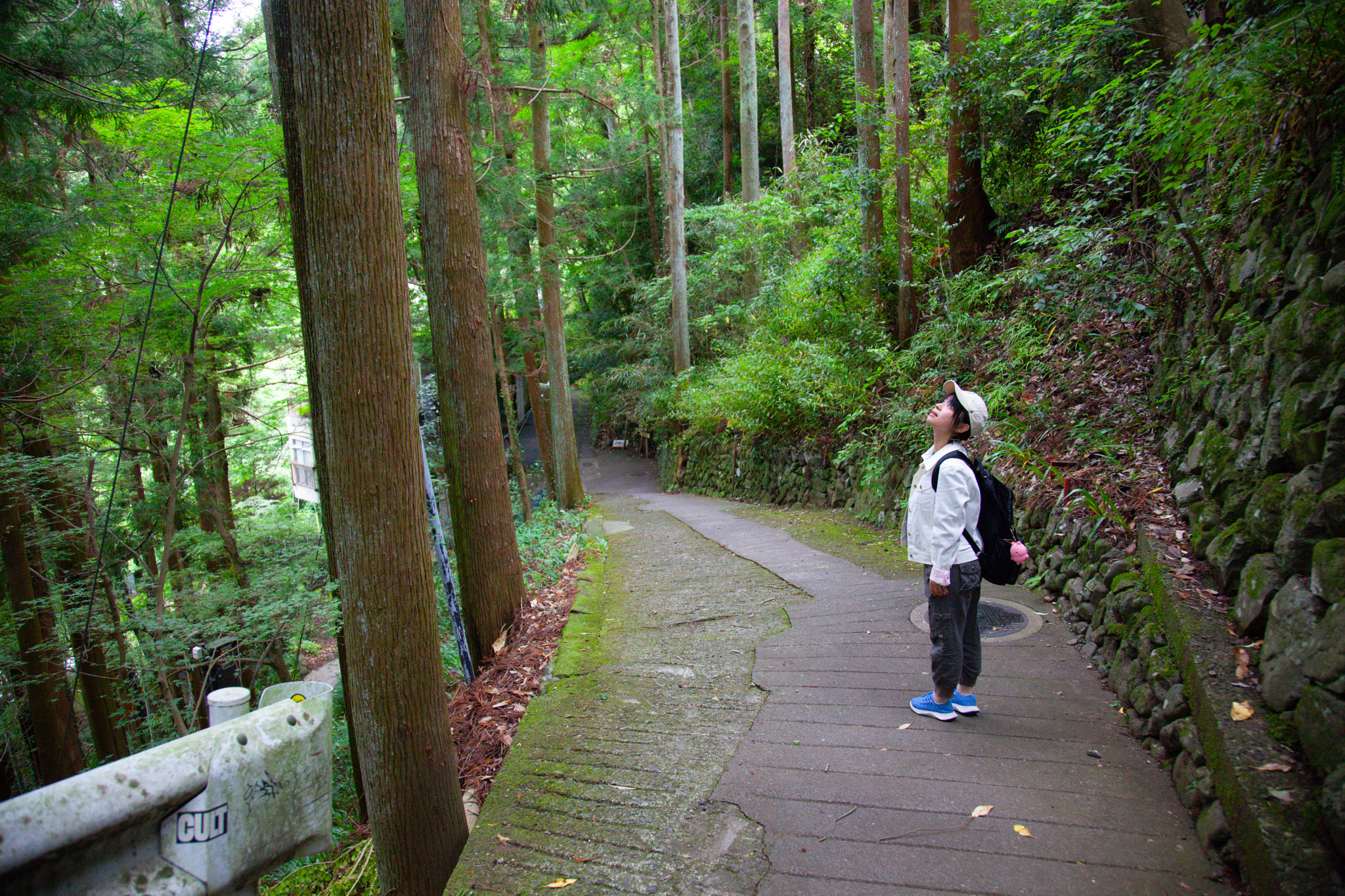
The promenade through the cedars. Cool, quiet, and a good few degrees cooler than the city.
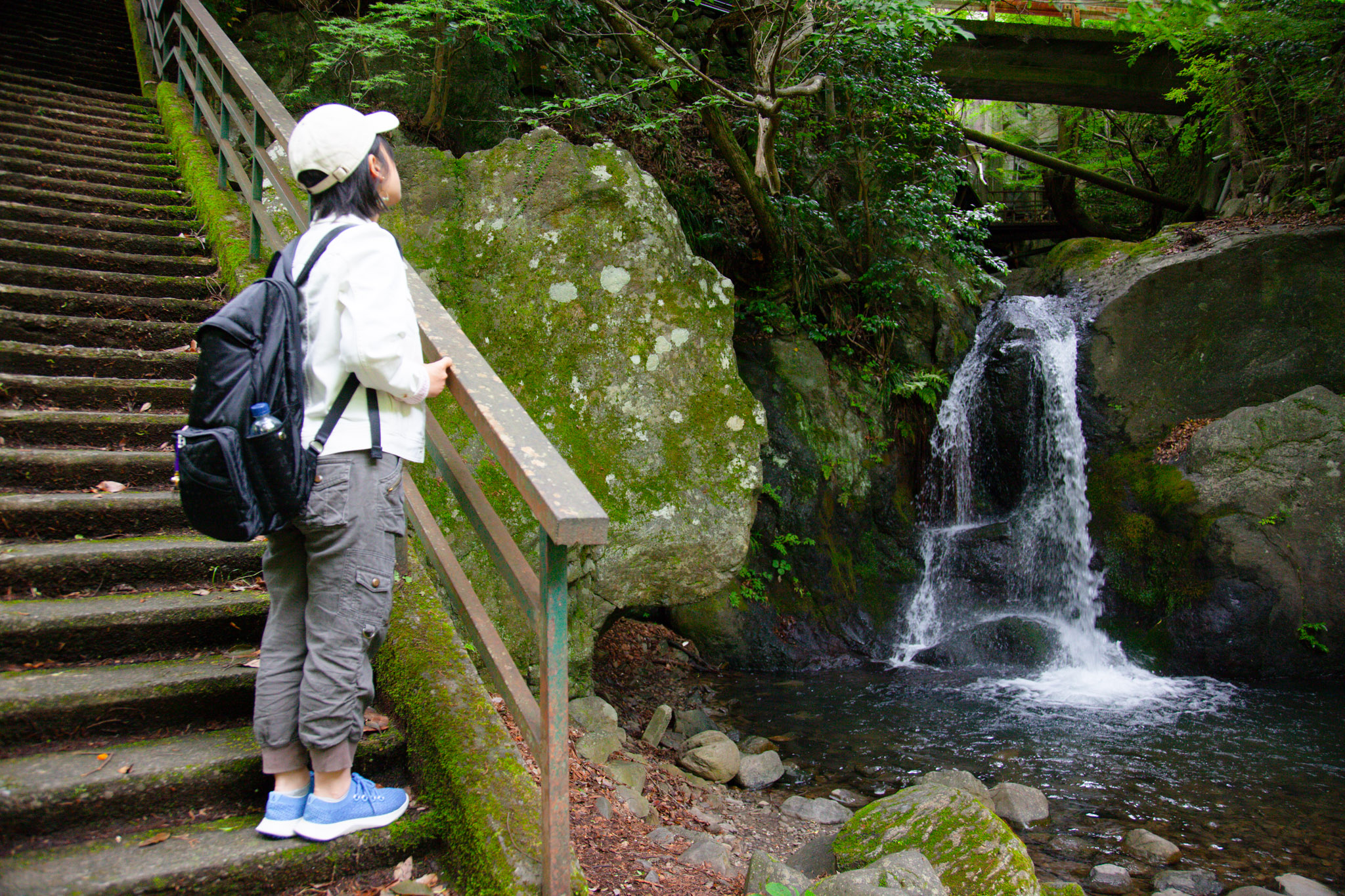
A small waterfall and a shrine along the path. The whole walk is full of these little stops.
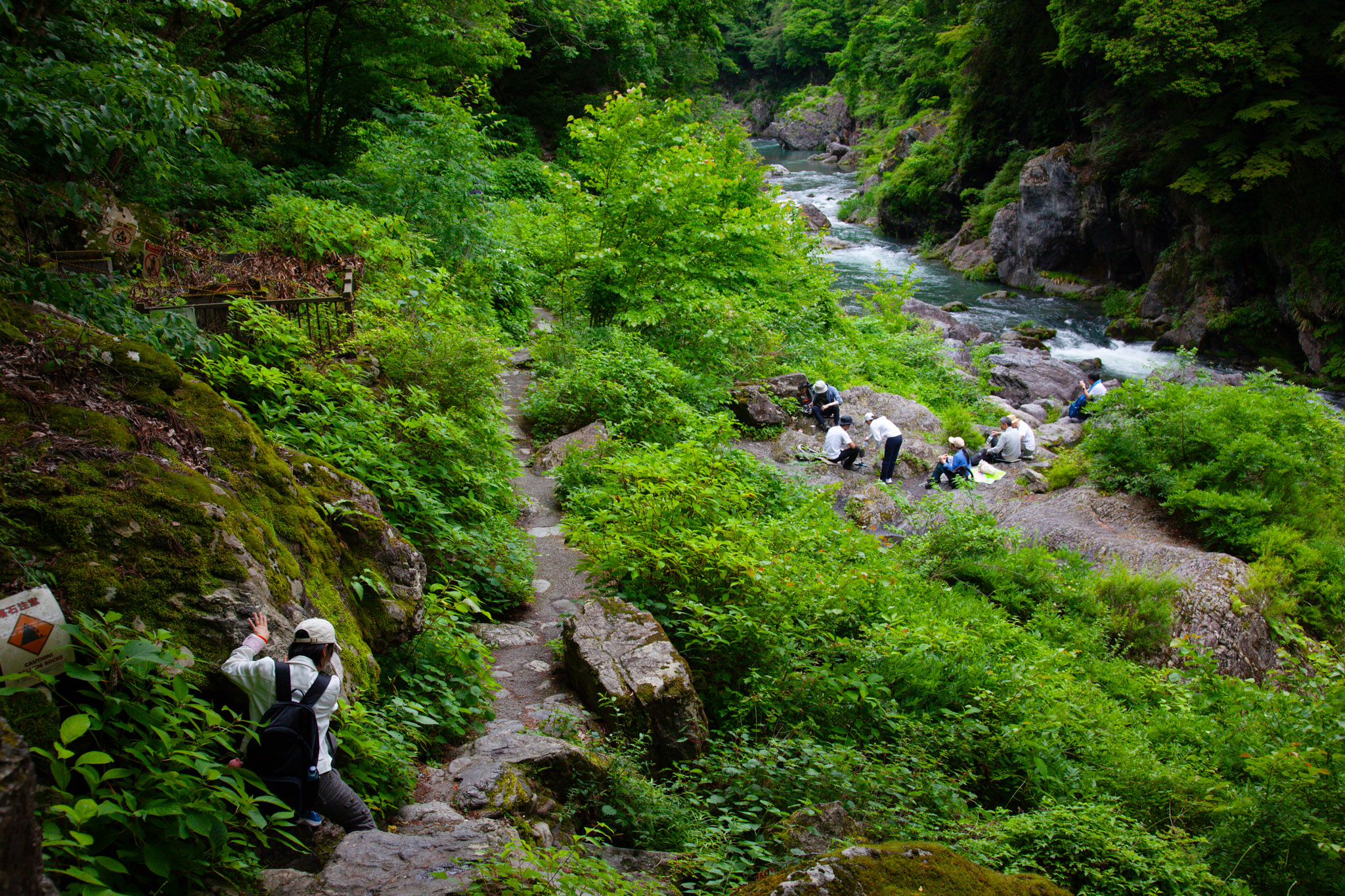
Down toward the water. People scramble onto the rocks here to get close to the river.
The Suspension Bridge
The centerpiece of the walk is the suspension bridge — Hatonosu-kobashi (はとのすこはし). It's a narrow wooden footbridge slung across the gorge, high above the river, and it moves under you the way suspension bridges are supposed to. From the far side you get the classic view: the bridge strung between the cliffs, dwarfed by the wall of green behind it.
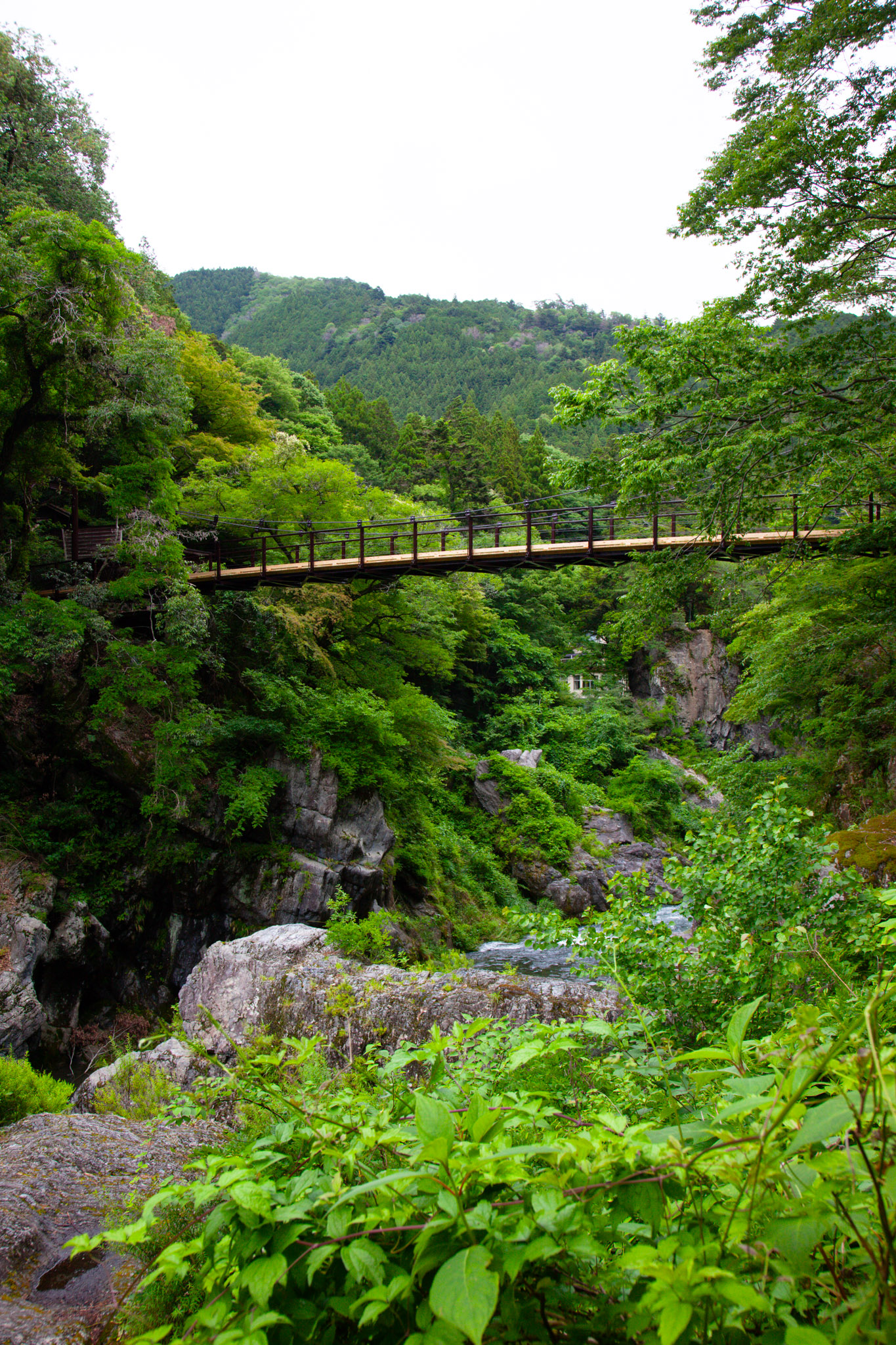
Hatonosu-kobashi from across the gorge. It looks small because everything around it is enormous.
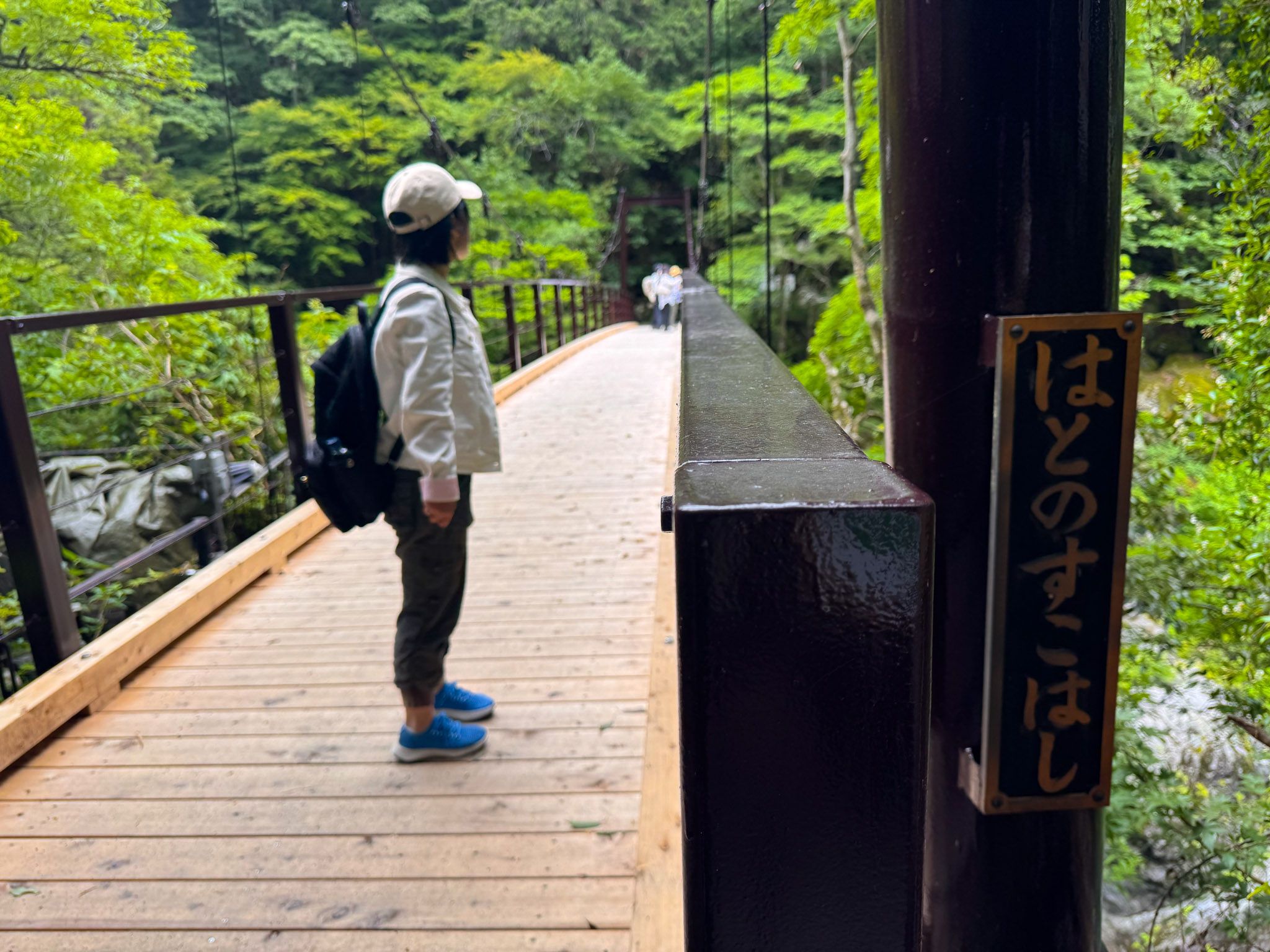
On the bridge. The post reads はとのすこはし — Hatonosu-kobashi.
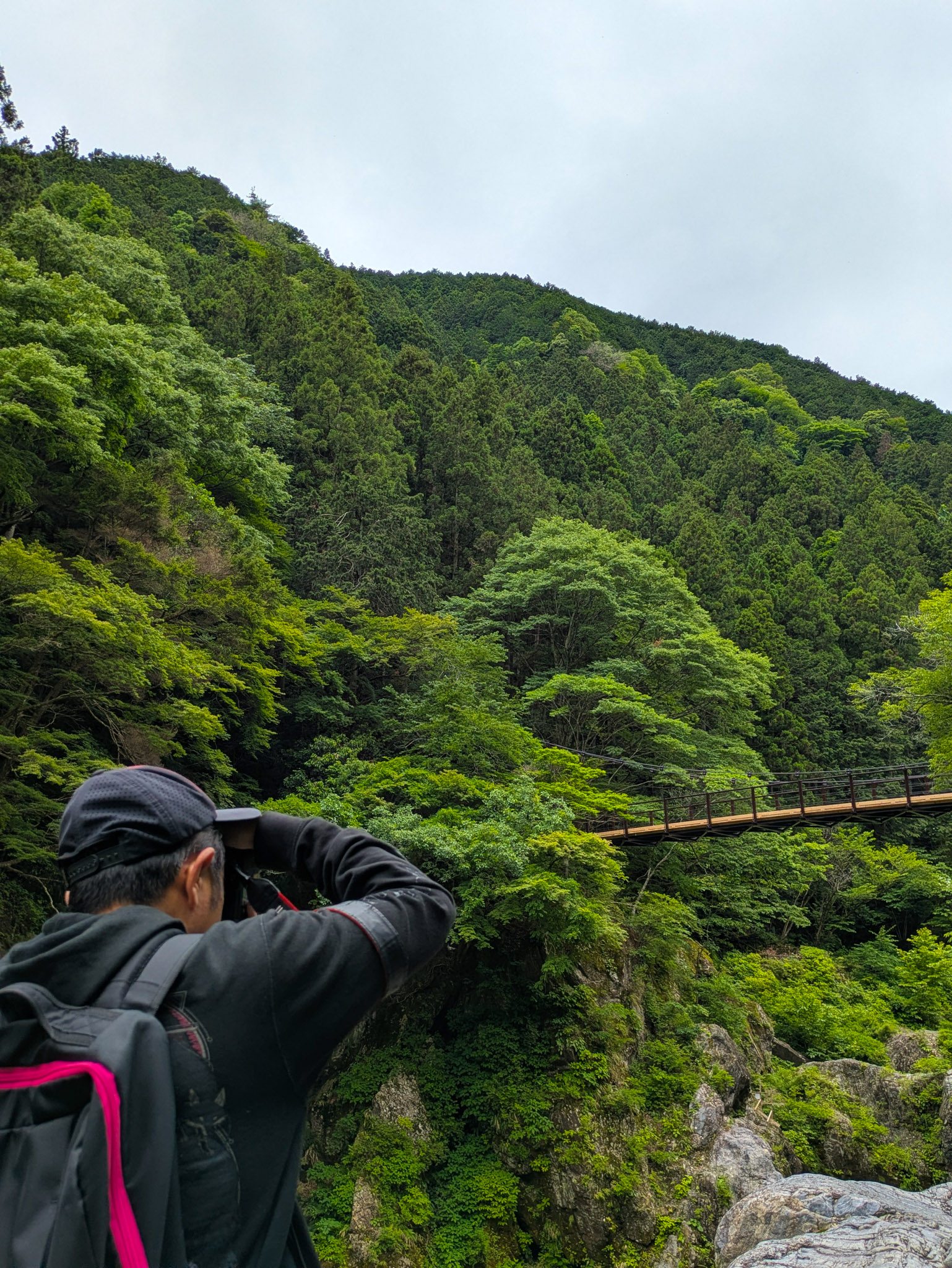
John getting the bridge shot. Someone has to.
The Dam and the Walk Back
Upstream from the gorge sits the Shiromaru Dam (白丸ダム) — a regulating dam on the Tama River that holds back a long, still reservoir of that same green water. It's a working piece of infrastructure rather than a tourist sight, but the view down onto the spillway and the turbine house, set into all that forest, is worth the look.
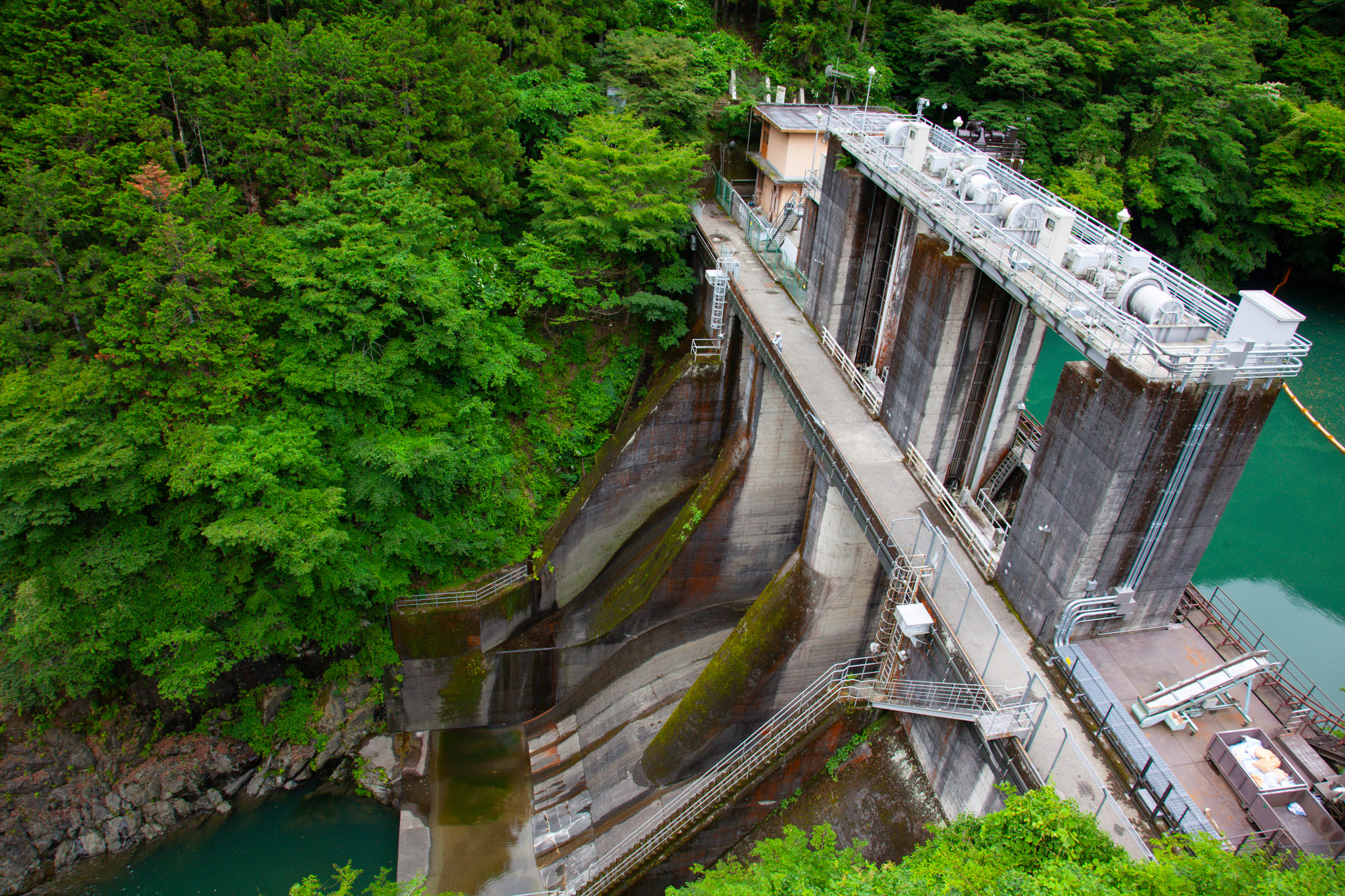
The Shiromaru Dam, just upstream. Concrete and moss, holding back a reservoir of that same impossible green.
For the way back we came up out of the gorge and walked the road along the rim — narrow, guardrail on one side, a long drop to the river on the other, with a green water pipe running the whole length of it. You get the gorge from a different angle up here, looking down through the trees at the river you'd just been standing beside.
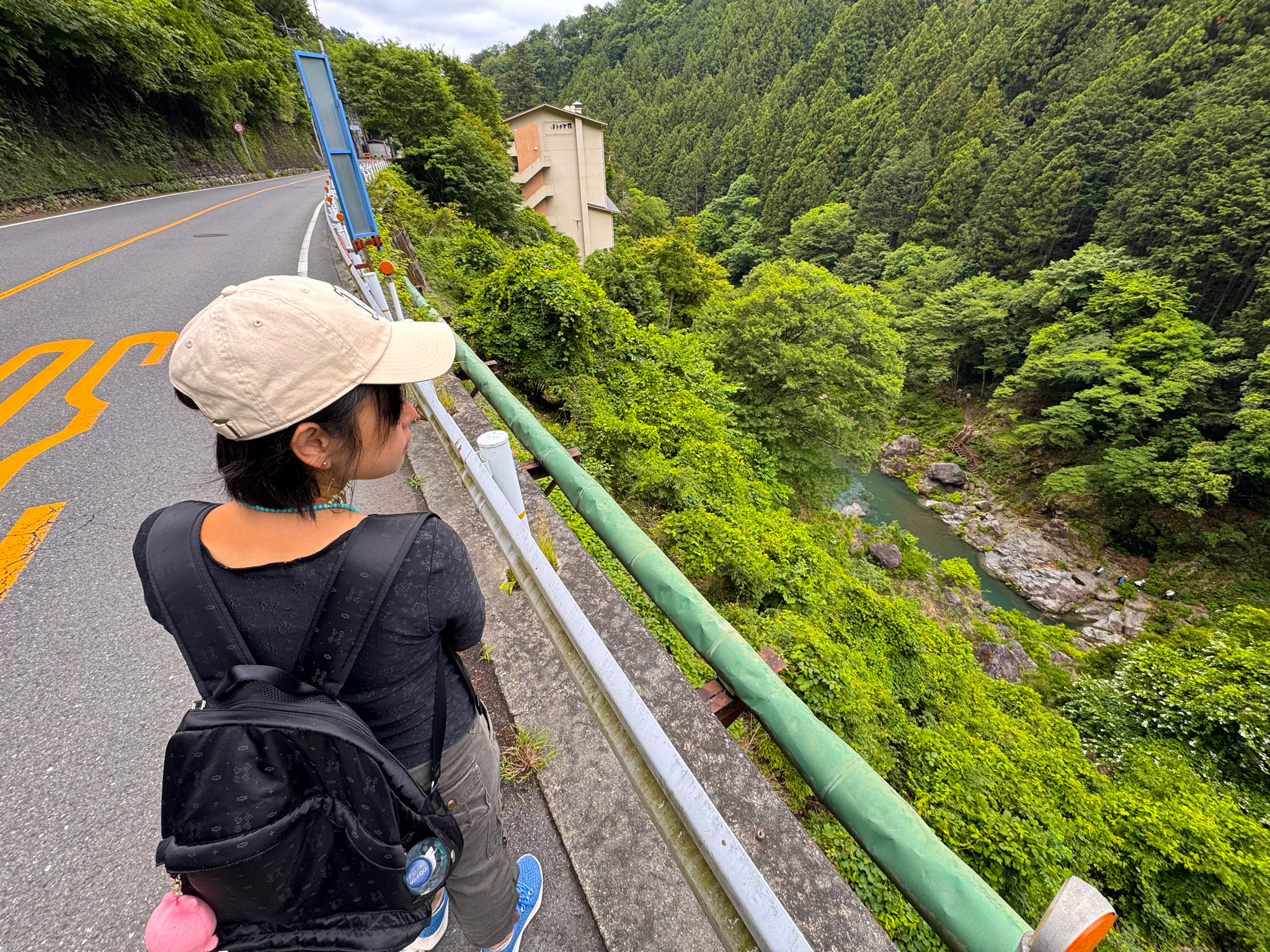
The road back along the rim. The river is somewhere down there to the right.
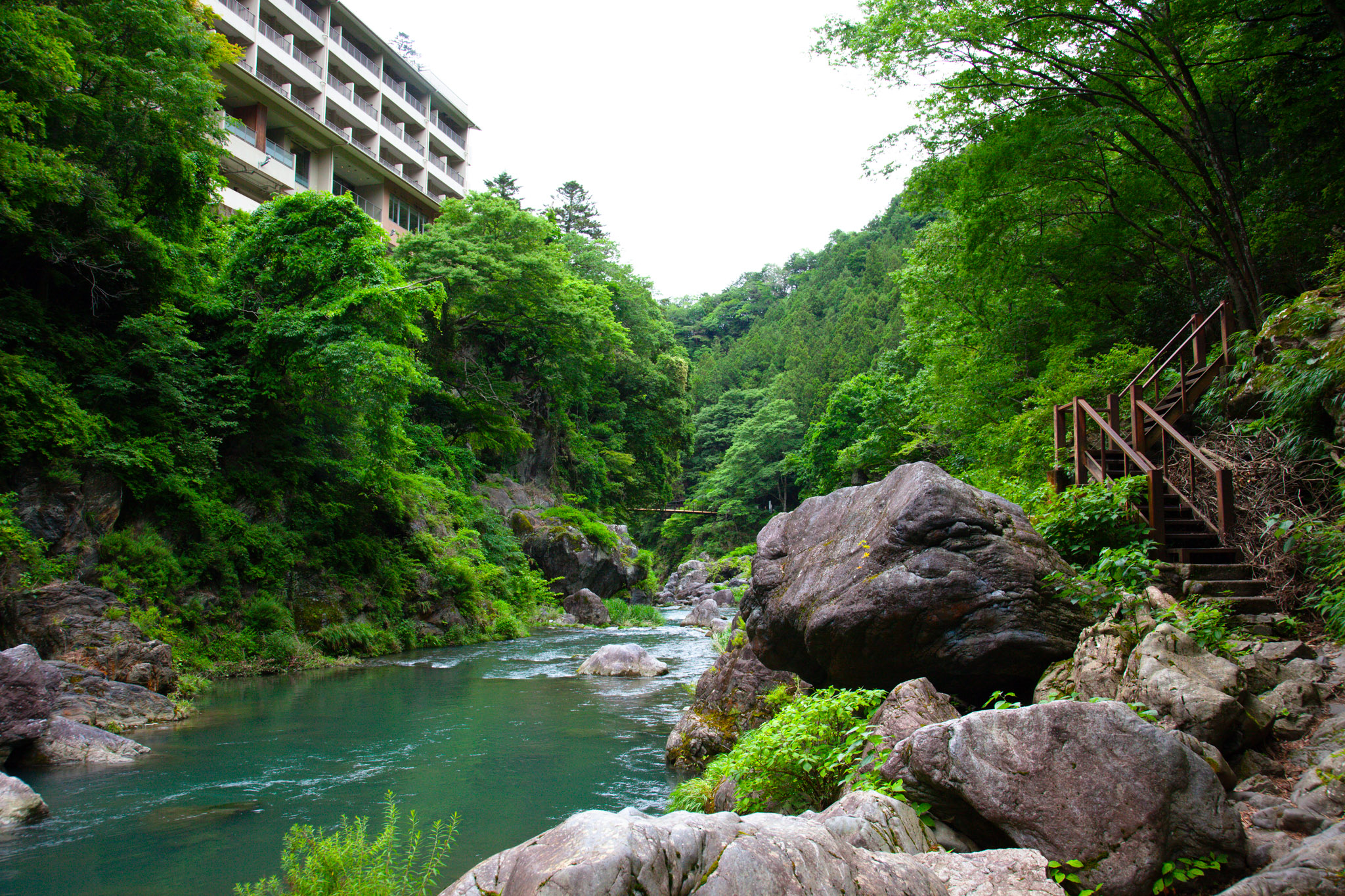
A riverside inn perched right over the water. People stay out here just for this.
One sign on the walk back stopped us cold — not for the view, but for the English. A carved wooden marker pointing the way to the "Sightseeing Toilet." We have no notes. It's a great country.
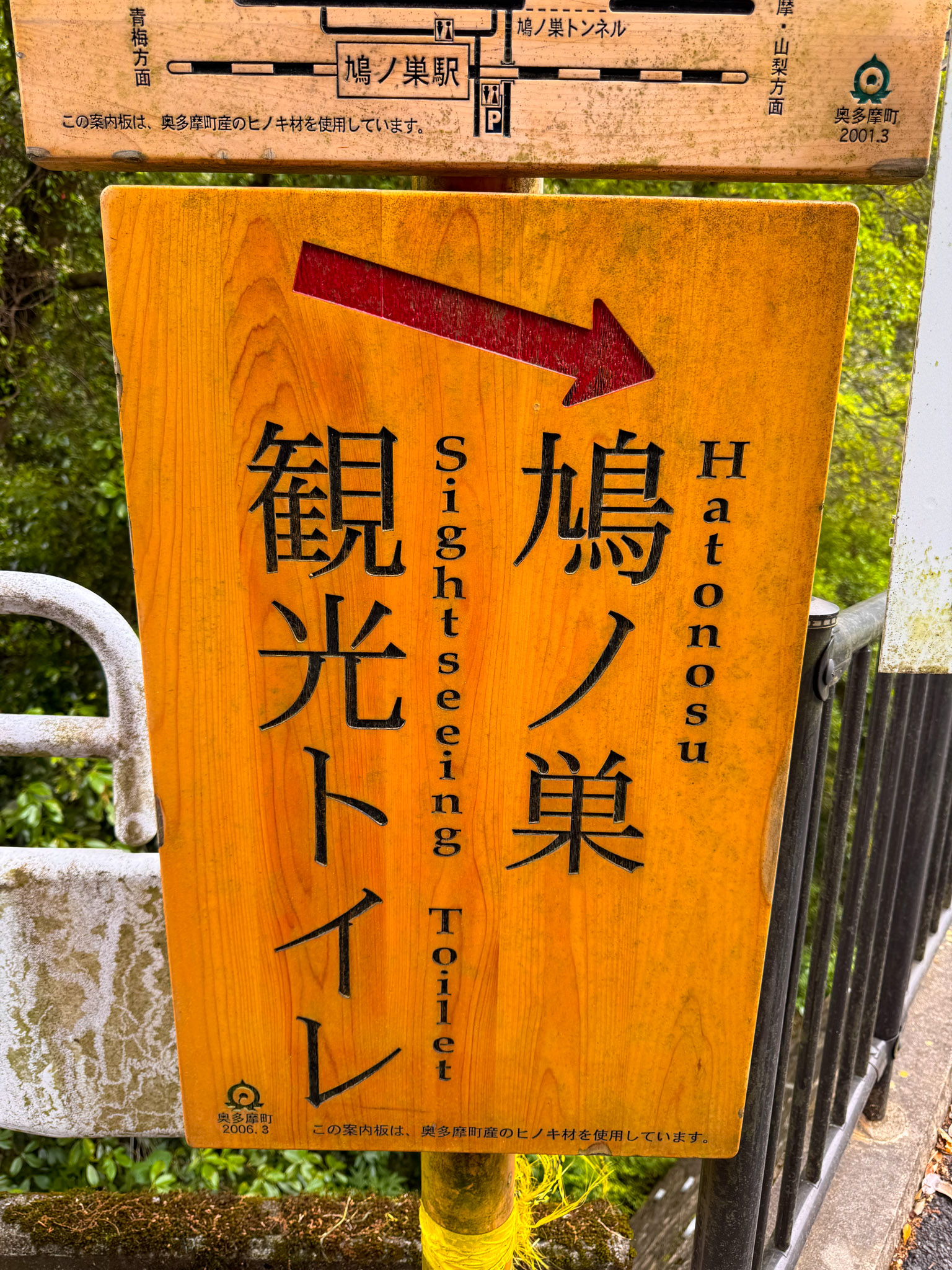
The "Sightseeing Toilet." The English made our day. Given the view from up here, though, the name's not entirely wrong.
Café Poppo, Over the Canyon
Somewhere on the walk back we spotted a hand-painted sign zip-tied to the guardrail: 絶景カフェ ぽっぽ — "Scenic Café Poppo." Zekkei means a spectacular view, and the sign was promising one. We followed it.
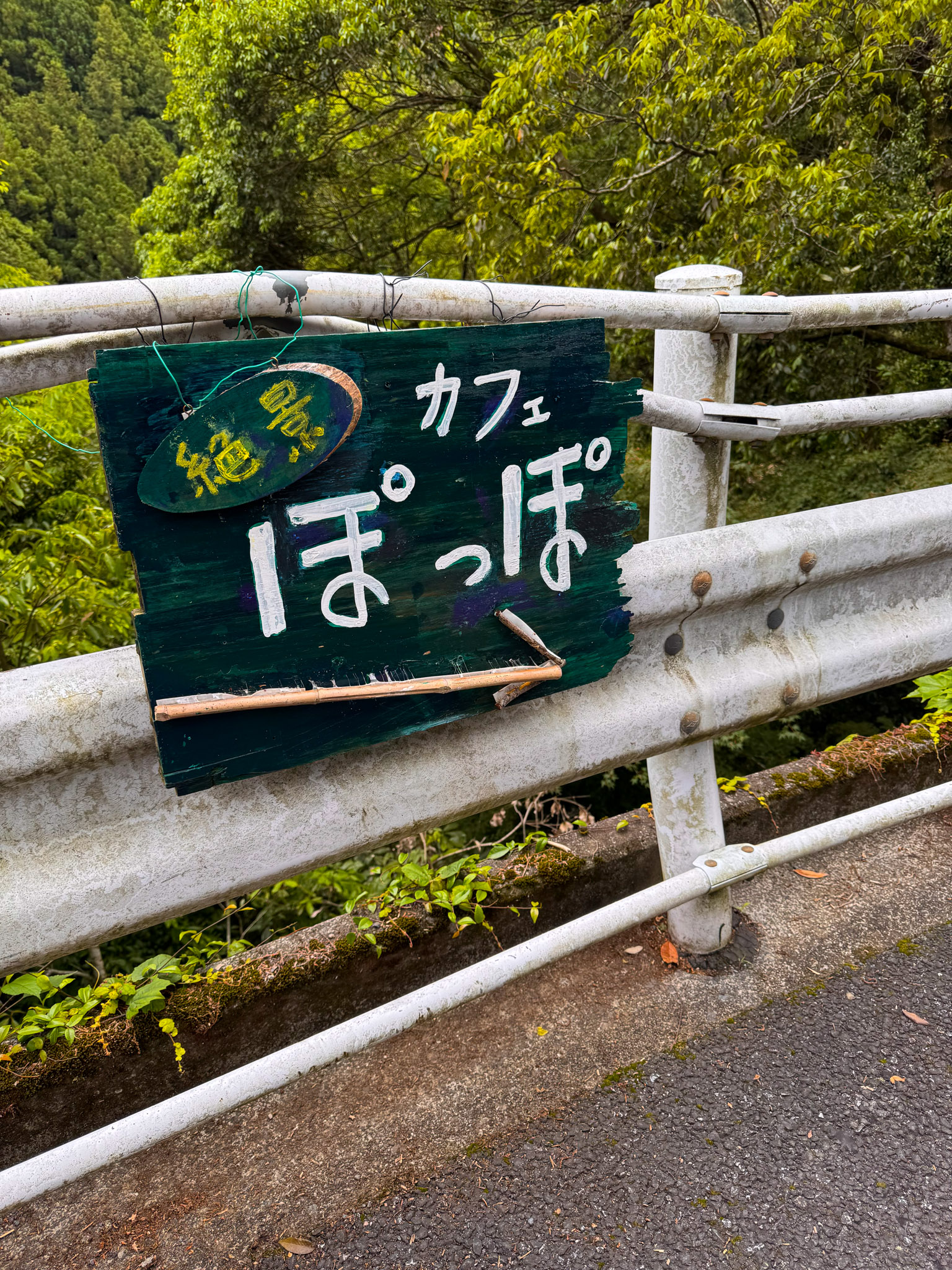
The sign that found us. 絶景カフェ ぽっぽ — scenic café Poppo.
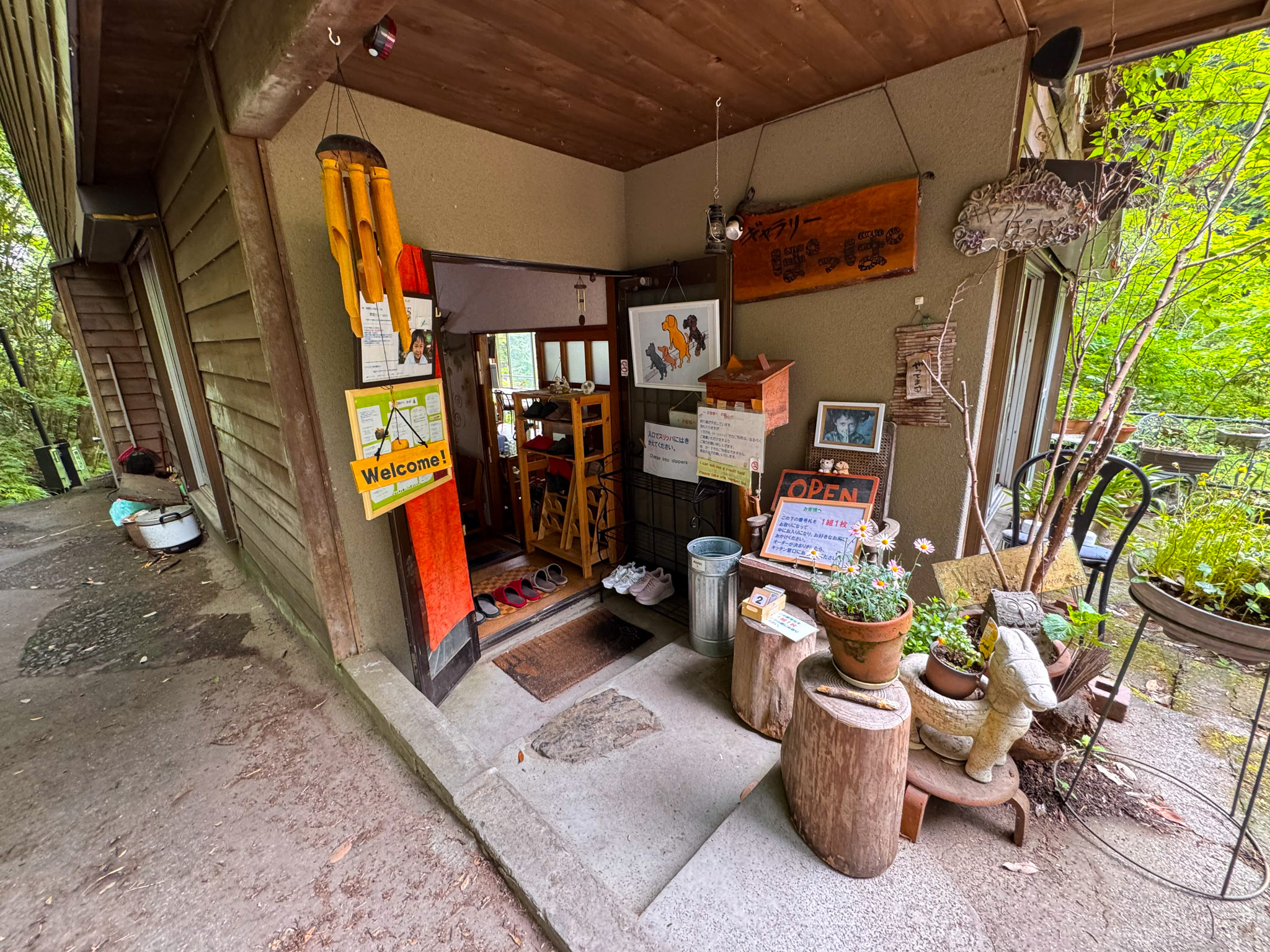
The entrance. Wind chimes, a Welcome board, and a stack of clogs at the door.
Inside, the whole far wall is glass, and the glass looks straight out into the gorge. One long communal table runs the length of the room with mismatched wooden chairs — clearly somebody's labor of love over a long time. You sit down and the canyon is right there: a wall of green leaves, the river somewhere below.
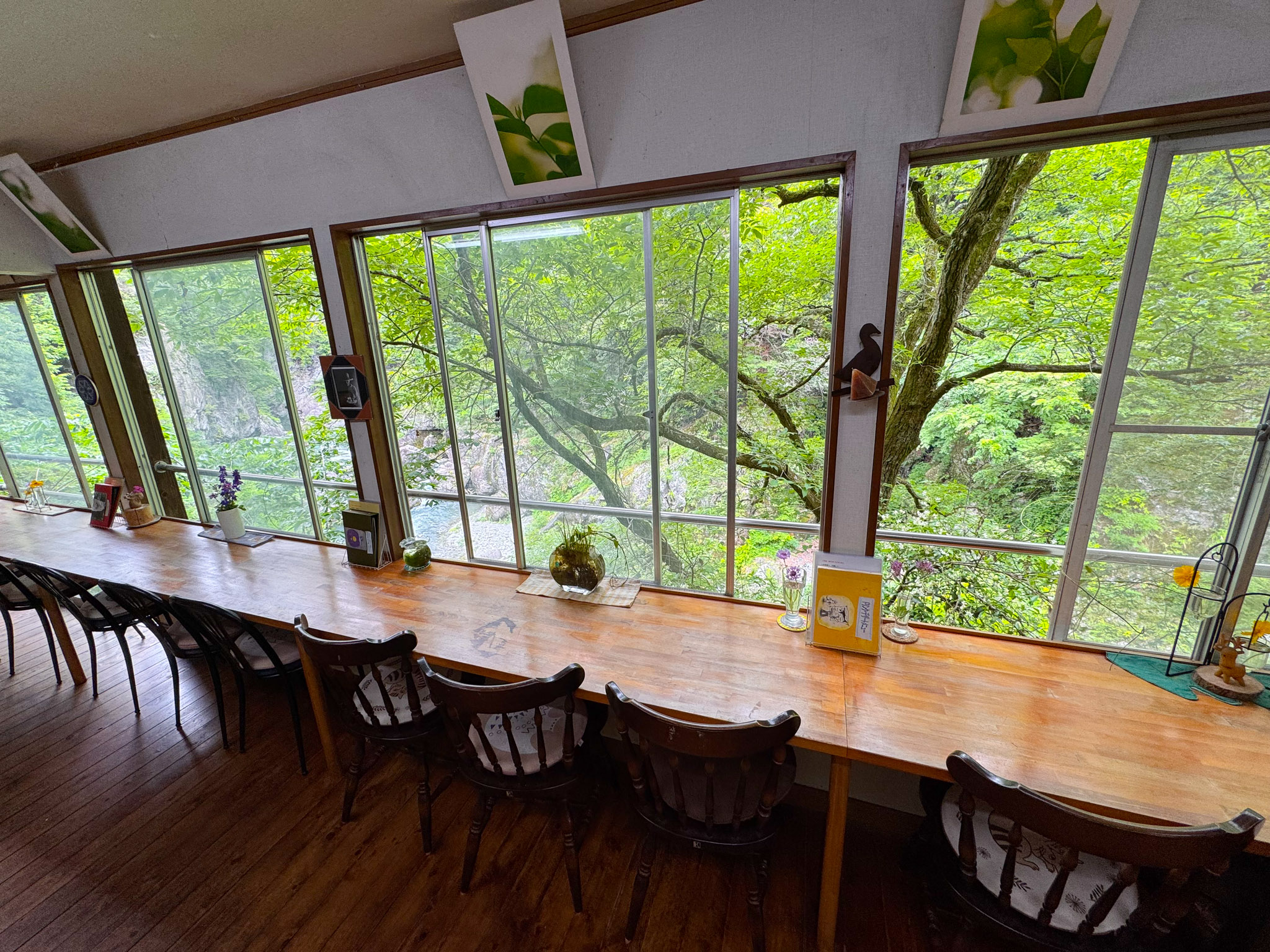
The whole wall is a window into the gorge. The zekkei the sign promised.
We ordered cold brew and a slice of tofu cheesecake with cream — light, not too sweet, and exactly right after a couple of hours of walking. We sat for a long while. There's no reason to hurry at a place like this.
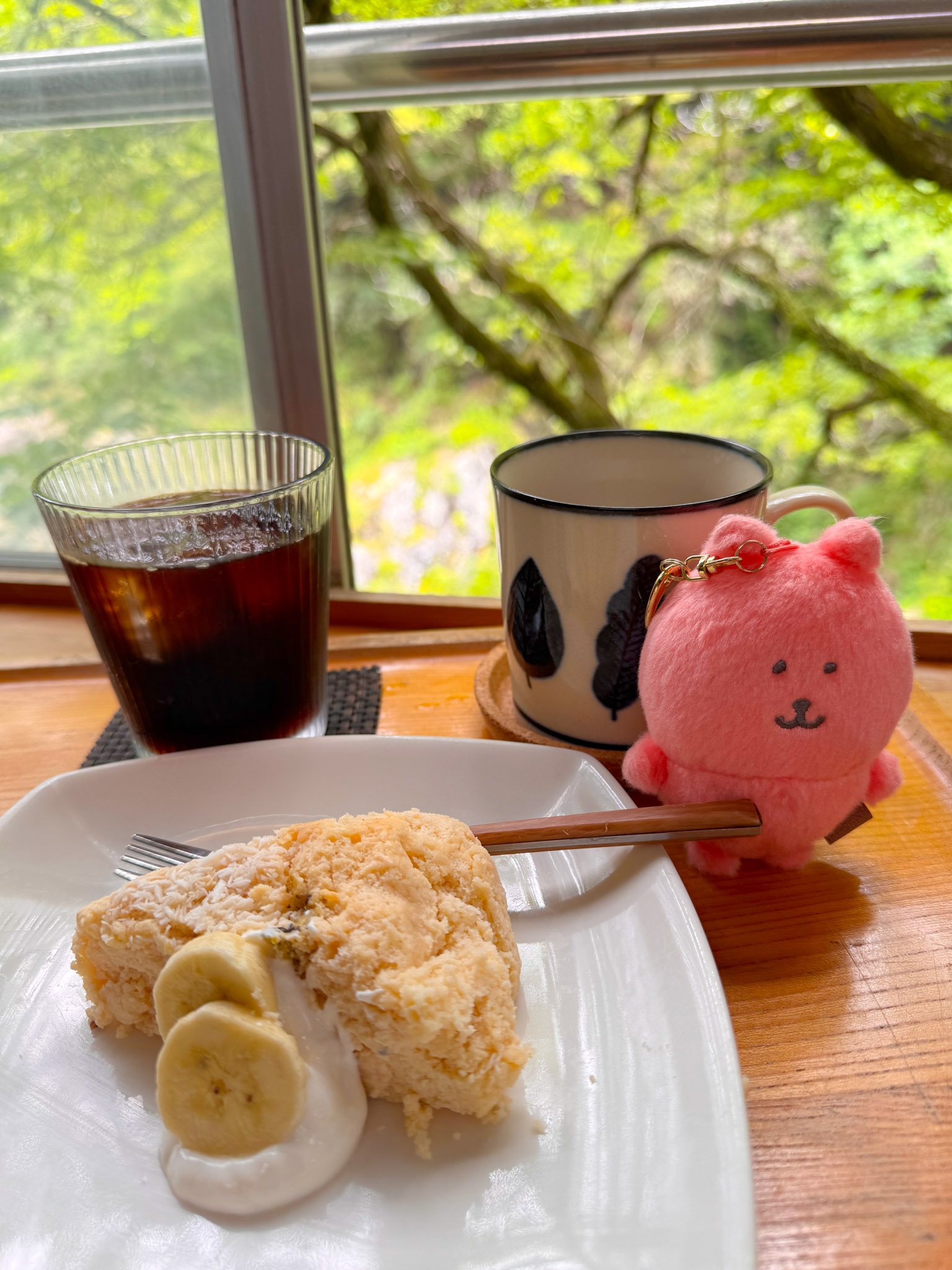
Cold brew, tofu cheesecake with cream, and the view. Joke Bear got the window seat.
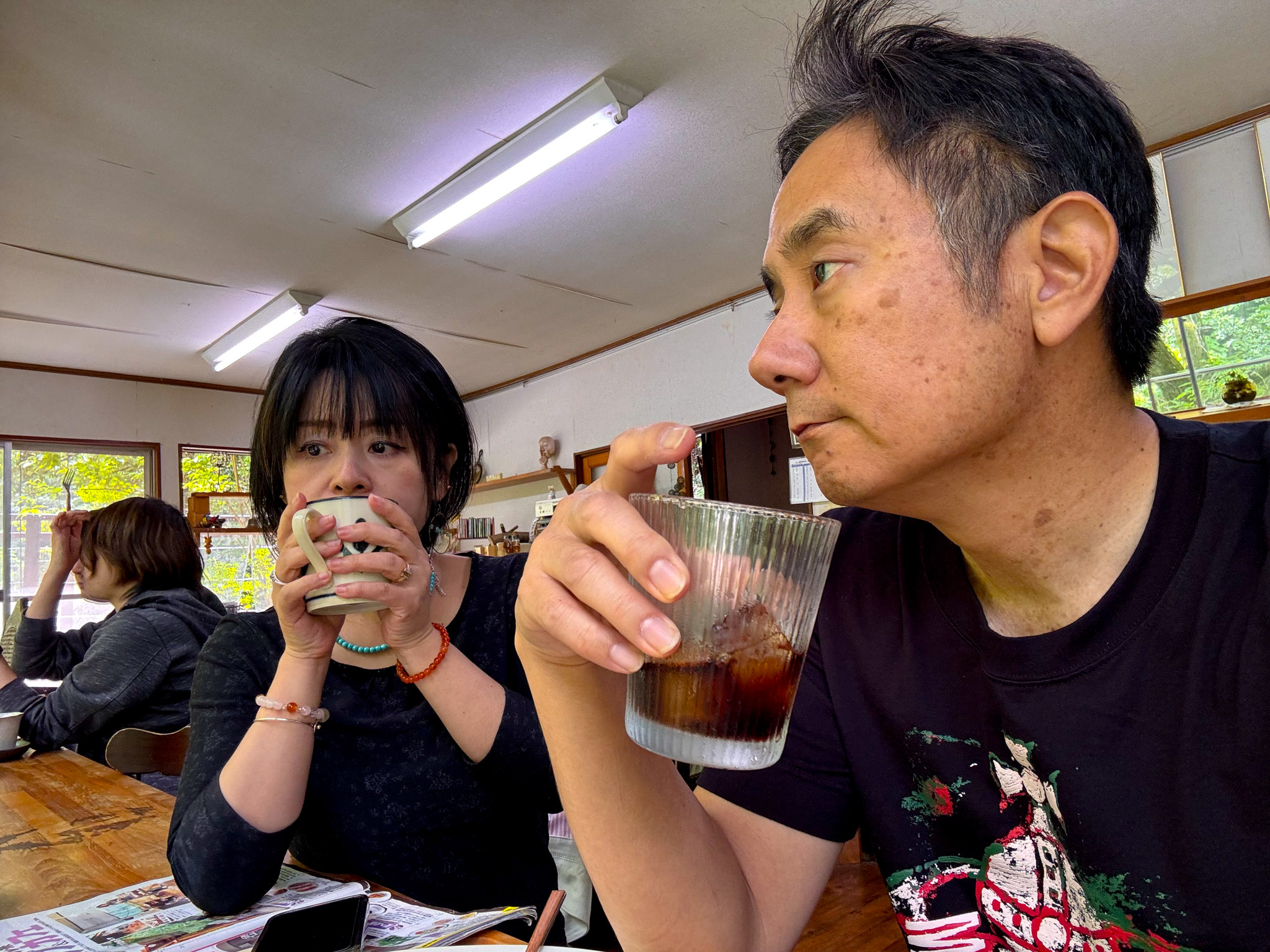
The Small Kine rest stop. Earned it.

Hatonosu has a small cluster of these places near the station — Poppo over the gorge, the frog-mural Kikori Café up by the road, and a little stand by the trailhead. We grabbed a tamago sando — the classic Japanese egg-salad sandwich, soft white bread and all — to eat outside before heading back to the platform.
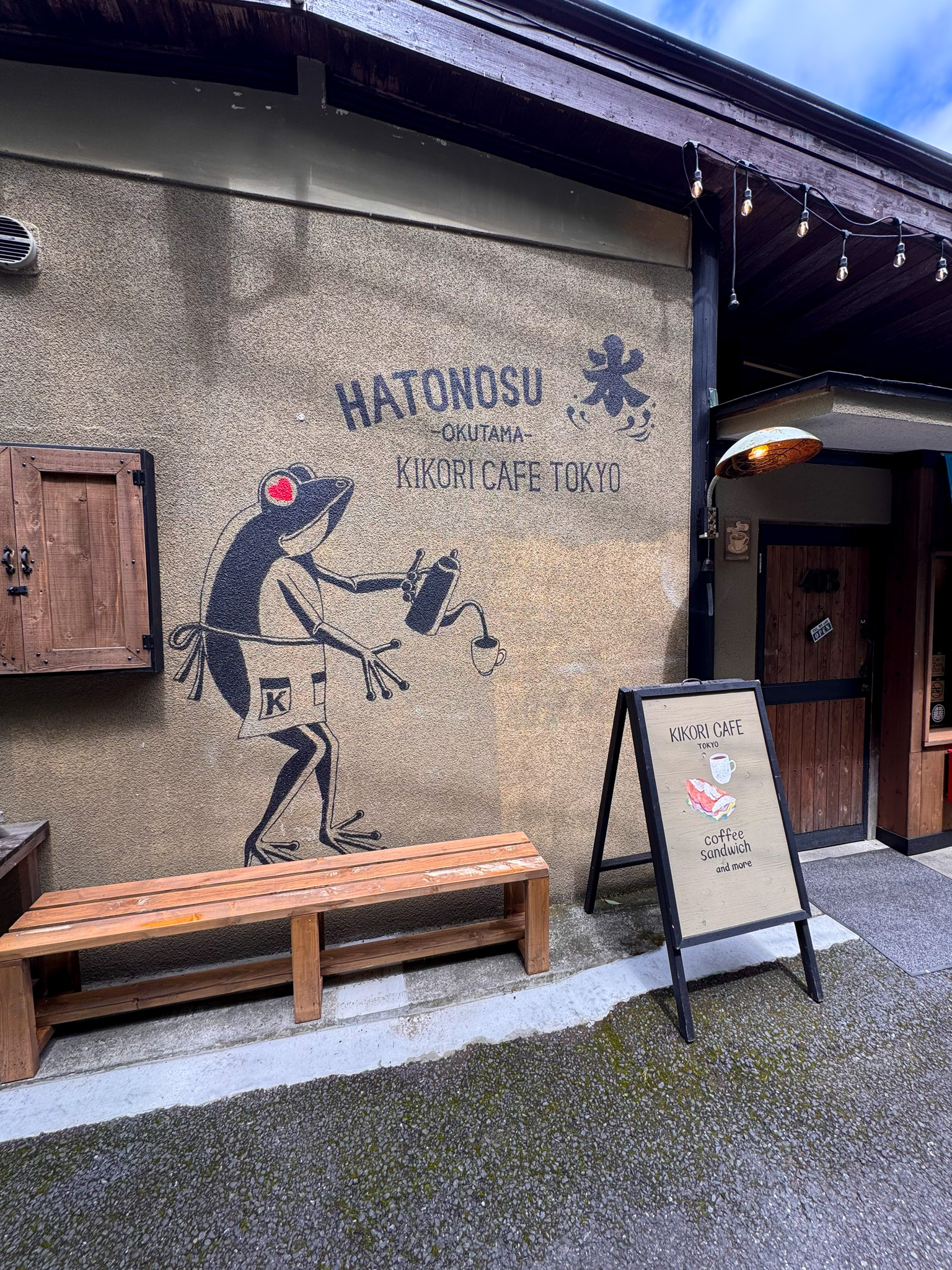
Kikori Café, up by the road. The frog has the right idea.
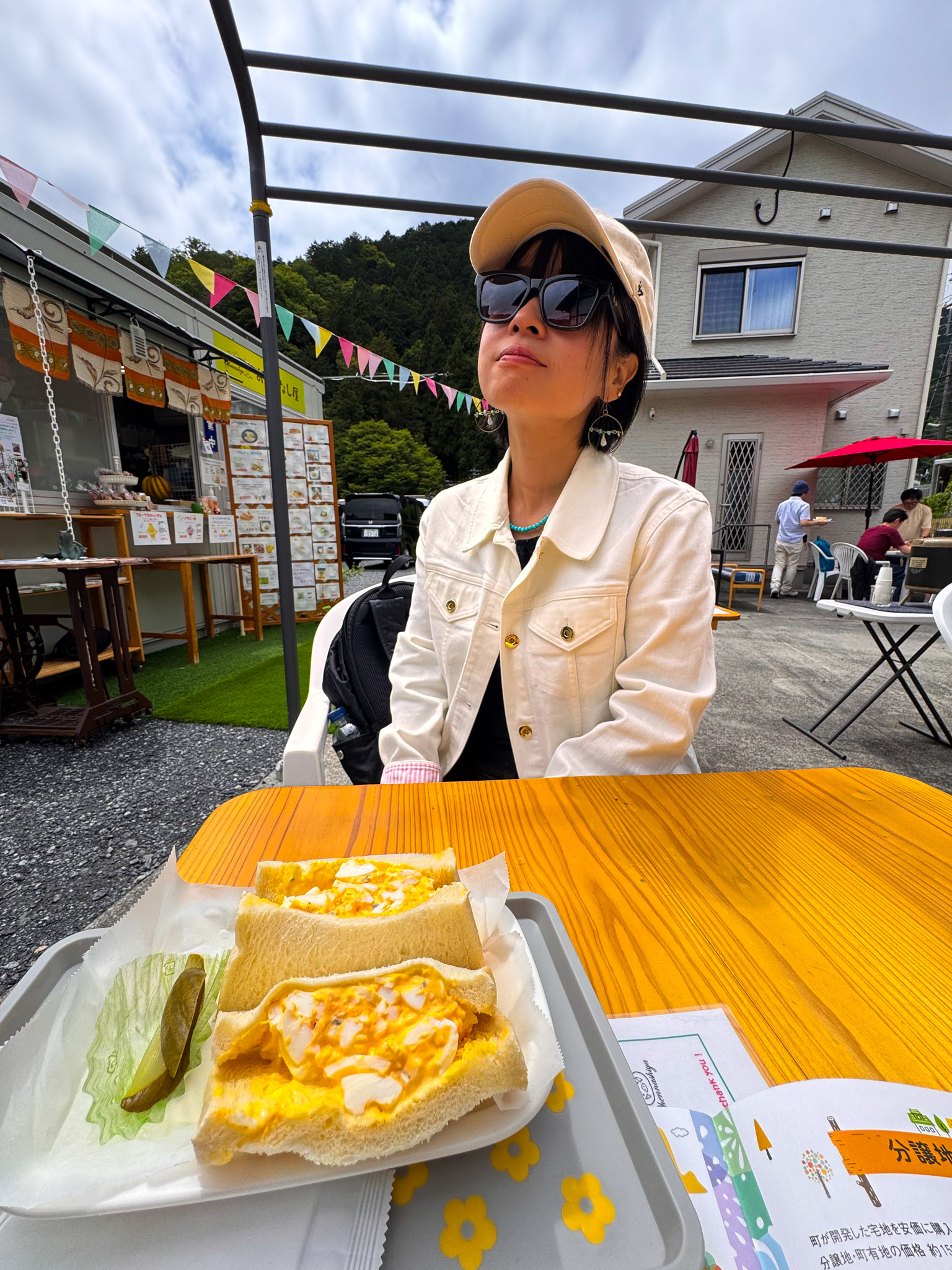
Tamago sando in the open air. A perfect, unfussy lunch.
Kichijoji on the Way Home
The Ome line eventually feeds back onto the Chuo line, and the Chuo line runs straight through Kichijoji — so we got off, because Ayumi wanted to see the Inokashira zoo. The zoo, officially the Inokashira Park Zoo (井の頭自然文化園), sits inside Inokashira Park, the big pond-centered park that's the main reason Kichijoji tops every "best place to live in Tokyo" list. We arrived with the late-afternoon light coming in low over the water.
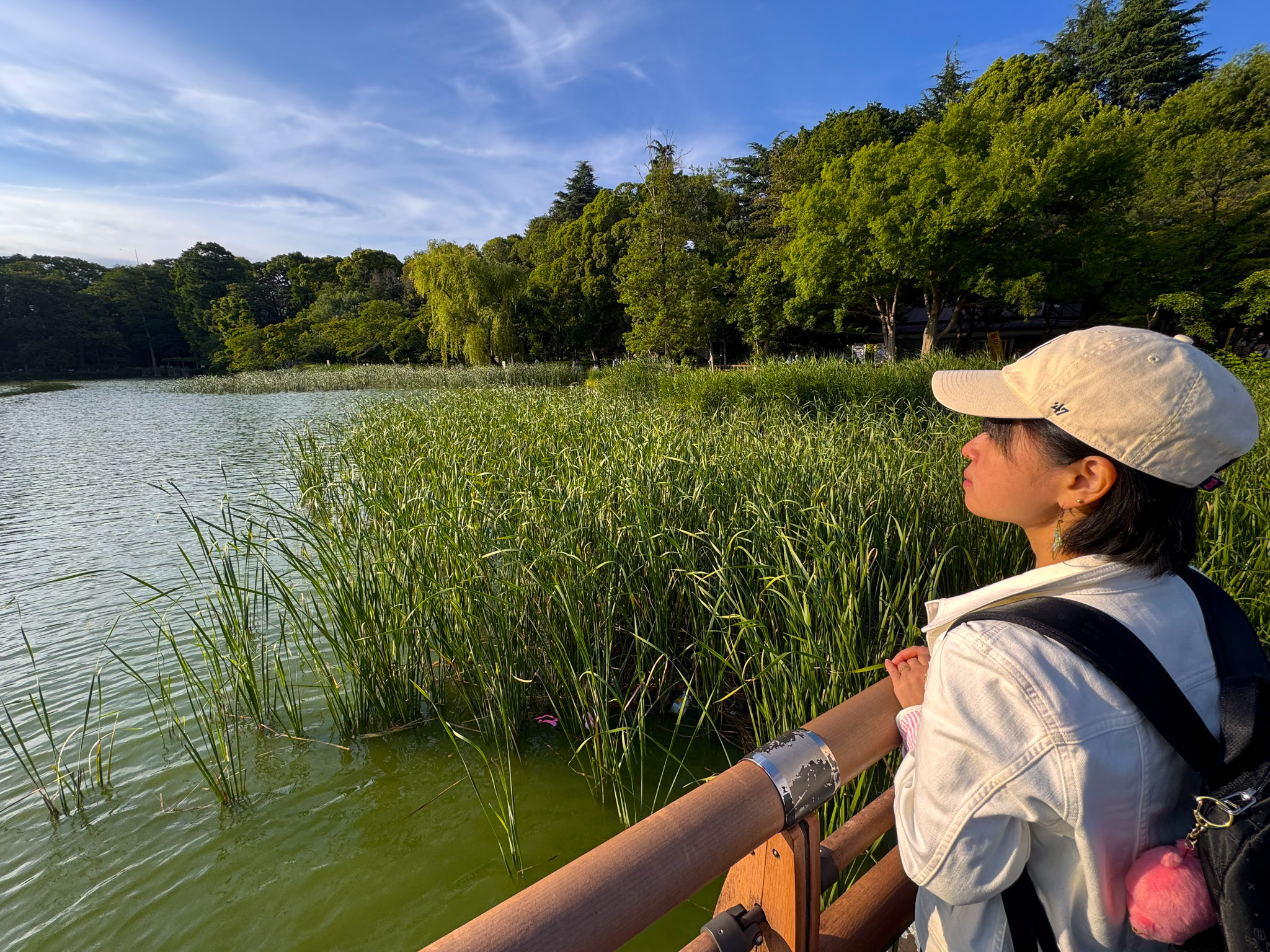
Inokashira Pond in the late light. From a Tokyo gorge to a Tokyo park in the same afternoon.
One of the zoo's quieter attractions is the squirrel enclosure — a walk-through cage where Japanese squirrels hop around on the logs at eye level. We got a good one, mid-snack, tail up, completely unbothered by us.
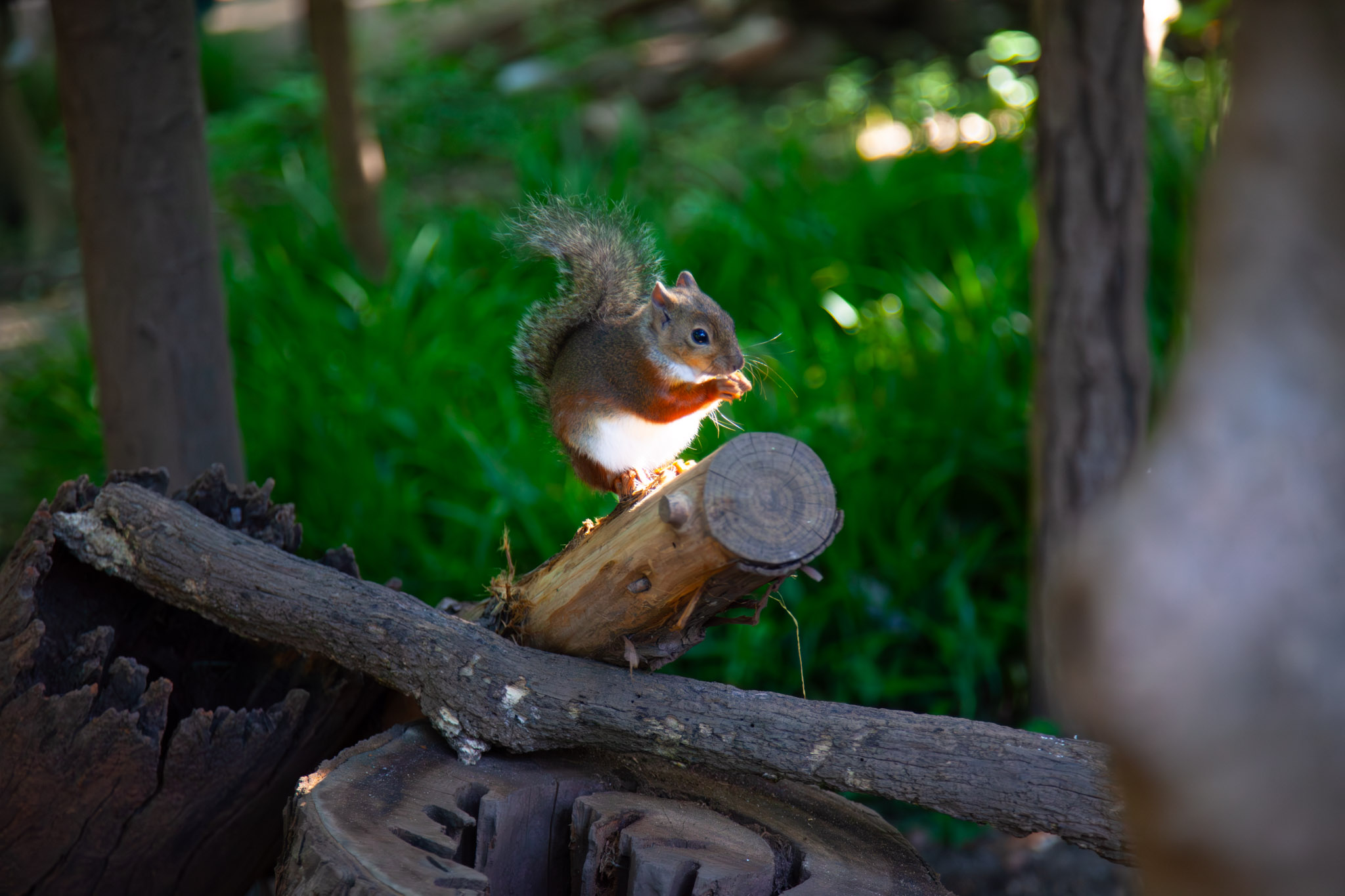
A Japanese squirrel mid-snack in the walk-through enclosure. Tail up, not a care in the world.
It was hydrangea season — June, full bloom — and the park was full of them, big mophead clusters in purple and white along the paths. Ayumi went straight for them with her phone.
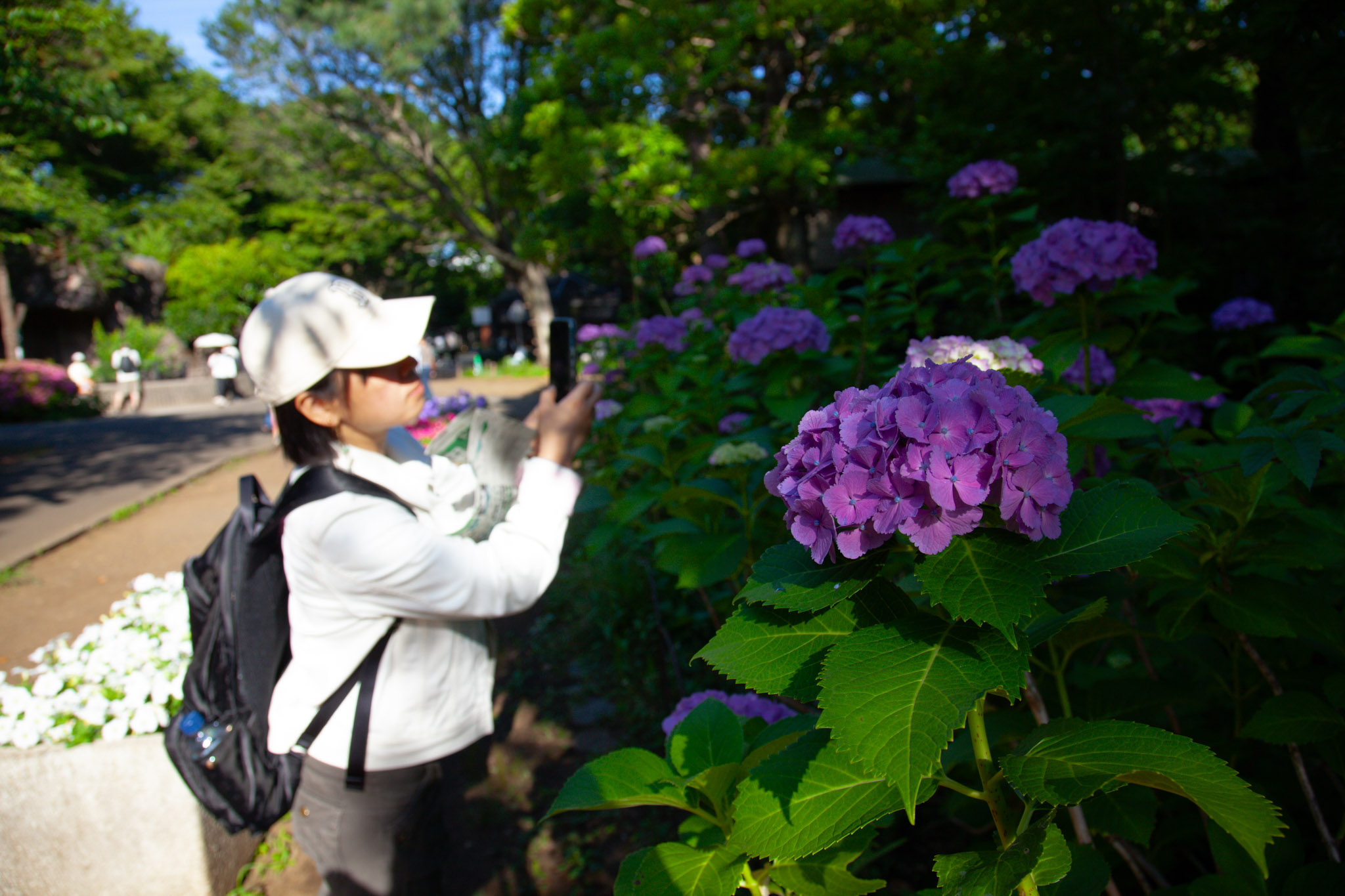
Hydrangeas in full bloom along the park paths. Peak June.
A Jealous Goddess and Grilled Mochi
By this point we'd been walking all day, and what we really wanted was something warm and sweet. We found it in yaki-mochi — grilled mochi on a skewer, charred and chewy, sold near the park. After a day like ours, it hit exactly right.
Here's the small bit of wordplay we love about it. Yaki-mochi (焼き餅) literally means "grilled rice cake." But yakimochi is also the everyday Japanese word for jealousy — to be jealous is "yakimochi o yaku." The pun rides on yaku, which means "to grill," and, written with a different character (妬く), "to burn with envy." There's a second, fonder explanation people tell: the way grilled mochi swells and puffs up on the fire looks like the puffed-out cheeks of someone sulking. Ours leaned all the way into it — little painted faces, one content, one decidedly not.
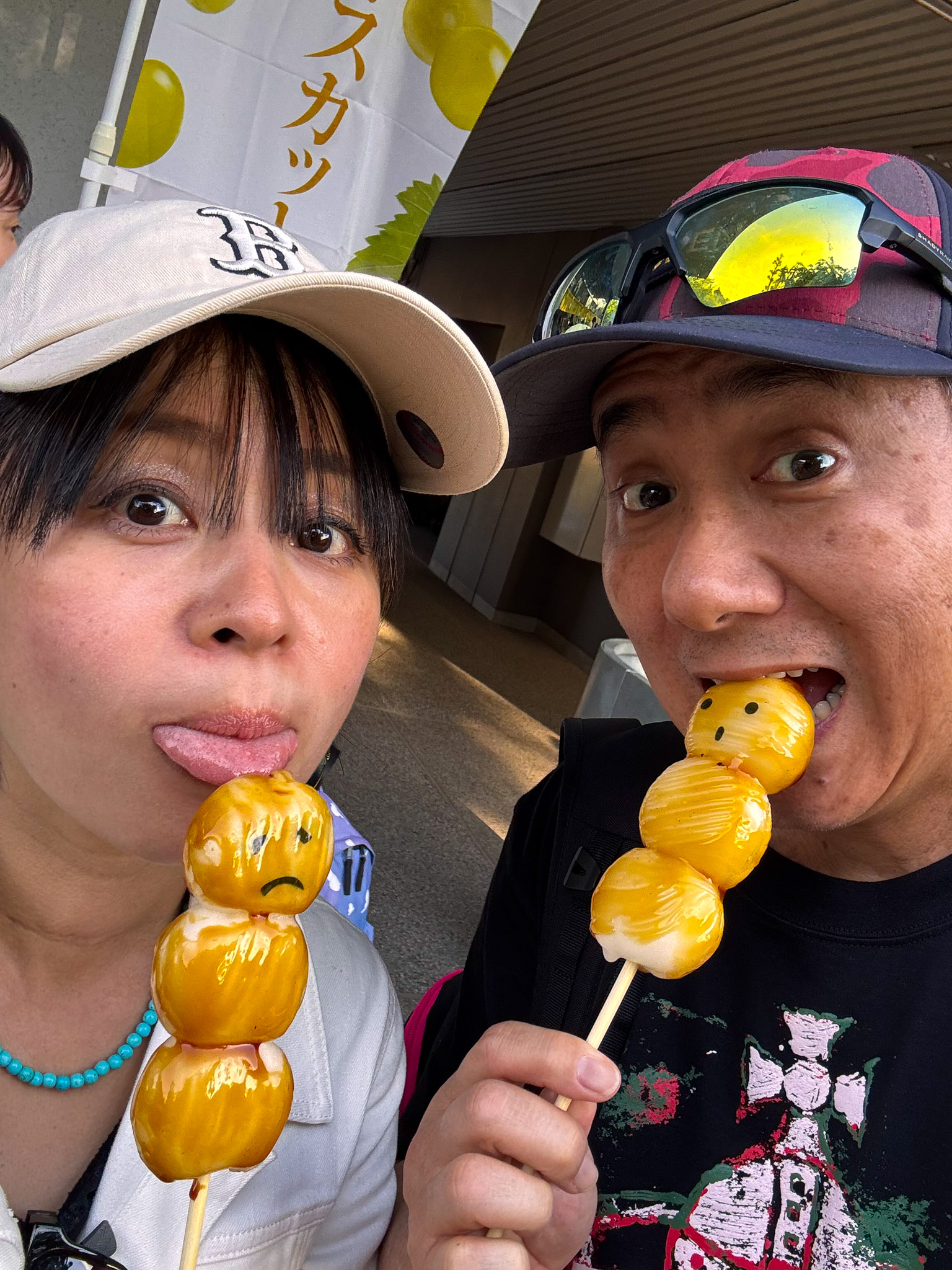
Yaki-mochi to finish. Hers frowning, his smiling. Make of that what you will.
And it's a fitting thing to eat at Inokashira, of all places. The deity enshrined on the little island in the pond is Benzaiten — and Tokyo's most enduring dating legend holds that she is a jealous goddess. Couples who rent a rowboat on Inokashira Pond, the story goes, are fated to break up, because Benzaiten can't bear to see them happy. Nobody really believes it; everybody knows it. We stuck to the mochi, and skipped the boat.
Getting there: From Seibu-Shinjuku, take the Seibu line to Haijima, then transfer to the JR Ome line out to Hatonosu. (The line keeps going to Okutama — don't ride past your stop like we did.) IC cards work the whole way.
The gorge walk: The Hatonosu Keikoku promenade runs along the Tama River between Hatonosu and Shiromaru stations. Easy to moderate — stone steps and footbridges. Allow 1–2 hours with stops.
The suspension bridge: Hatonosu-kobashi (はとのすこはし) is a short walk down from the station. It sways. That's the point.
Shiromaru Dam: A short way upstream. The viewpoint over the dam and reservoir is free.
Café Poppo: 絶景カフェ ぽっぽ — a tiny scenic café with a wall of windows over the gorge. Cold brew and homemade tofu cheesecake. Worth seeking out.
Bring: Decent shoes, water, and time. It's cooler than the city, but the walk earns the coffee.
Inokashira Park (井の頭恩賜公園): A two-minute walk from Kichijoji Station on the Chuo line. Free. The pond, the boats, and the walking paths are the heart of it.
Inokashira Park Zoo (井の頭自然文化園): A small zoo inside the park with a walk-through squirrel enclosure. Modest admission.
When to go: June for hydrangeas, late afternoon for the light on the pond. Maybe skip the rowboat, just in case.